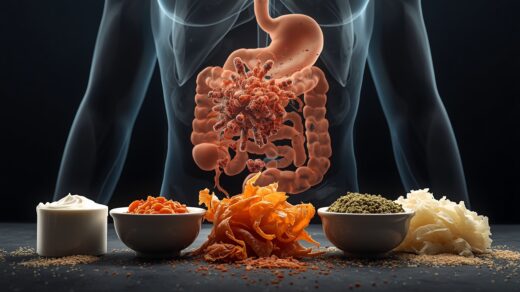

Fiber is one of the strongest links between diet and the gut microbiome. But “fiber feeds good bacteria” leaves out the most interesting part of the story.
You eat the oatmeal. Your microbes get part of the meal.
Some carbohydrates in oats, beans, whole grains, fruits, vegetables, nuts, and seeds resist digestion in the small intestine. When certain fibers reach the colon, microbes can break them down using enzymes your own digestive system does not have.
What happens next is the basis of one of the most familiar pieces of gut-health advice:
Eat fiber to feed your good bacteria.
That is not exactly wrong. It is simply much too tidy.
Different fibers feed different microbial pathways. Some fibers are barely fermented at all. Two people can eat the same fiber and have different microbial responses. And even when a fiber clearly increases a supposedly beneficial bacterium, that does not automatically mean the person became healthier.
The more accurate story is also the more useful one: fiber does not simply “feed the microbiome.” It changes what resources are available inside a complicated ecosystem—and what happens next depends on the fiber, the microbes already there, and the person they live in.
The First Problem: “Fiber” Is Not One Thing
A nutrition label makes fiber look like a single substance.
Ten grams is ten grams.
Your digestive system sees something much more complicated.
Fibers differ in chemical structure and in properties such as viscosity, water-holding capacity, and fermentability. Those differences determine what they can do as they travel through the digestive tract.
Some form gels that slow the movement and absorption of nutrients. Some absorb water and change stool consistency. Some contribute bulk. Others are readily fermented by microbes in the colon.
And some do several of those things at once.
This is why the familiar distinction between soluble and insoluble fiber tells only part of the story. Inulin, for example, is soluble and readily fermented. Psyllium is also soluble, but its gel-forming physical properties are central to many of its effects. Coarse wheat bran behaves differently from either.
So asking whether “fiber is good for the microbiome” is a little like asking whether “exercise is good for fitness.”
The answer is yes—but the type matters.
Why Your Microbes Get to Eat What You Cannot
Human digestion is extremely capable, but our enzymes cannot break every chemical bond in the carbohydrates we eat.
Some nondigestible carbohydrates therefore make it through the small intestine and reach the colon. There, microbes equipped with different carbohydrate-degrading enzymes can gain access to them.
Researchers sometimes call these microbiota-accessible carbohydrates: carbohydrates available for the gut microbiota to metabolize.
The term highlights something important. Reaching the colon is not enough. The microbial community also needs the machinery to use what arrives.
And not every fiber’s main job involves microbes.
Some fibers exert important effects by retaining water, adding bulk, changing stool consistency, or forming viscous gels. Fiber would still matter to human health even if we stopped talking about the microbiome.
But when fermentation does occur, things become especially interesting.
Fiber Does Not Just Become “Food for Bacteria”
Gut microbes do not simply consume fermentable fiber and multiply.
They transform it.
Among the products of microbial fermentation are short-chain fatty acids, particularly acetate, propionate, and butyrate. These compounds have different roles. Butyrate, for example, is an important fuel for cells lining the colon, while short-chain fatty acids also participate in signaling related to intestinal and metabolic physiology.
But the process is rarely the work of one microbe acting alone.
One organism may break a complex carbohydrate into smaller compounds. Another may consume those compounds. A third may use the second organism’s metabolic products.
This microbial handoff is called cross-feeding.
It means eating one fiber can influence organisms that never directly consumed that fiber at all. What enters the colon is not simply feeding individual species; it can alter a network of metabolic exchanges.
That is why the microbiome is better imagined as a food web than a collection of “good bacteria” waiting to be fed.
It also explains why microbiome measurements can be deceptively difficult to interpret.
Take butyrate. Finding more of it in stool might sound automatically desirable. But a stool measurement reflects what remains after production, microbial reuse, absorption by the intestine, and transit through the colon. It is not a direct tally of everything microbes produced.
A stool sample can tell researchers a great deal.
It is not a complete metabolic balance sheet.
Yes, Some Fibers Really Do Favor Particular Microbes
The effects are not completely unpredictable.
Inulin-type fructans are a good example. A systematic review and meta-analysis of 50 studies involving 2,525 participants found that chicory-derived inulin-type fructans reliably increased the abundance of Bifidobacterium.
A broader meta-analysis of 64 randomized fiber studies involving 2,099 healthy adults found a similar pattern. Fiber interventions increased Bifidobacterium and, more modestly, Lactobacillus, with fructans and galacto-oligosaccharides producing some of the clearest effects.
That sounds like strong evidence for “feeding good bacteria.”
Here is the catch:
More of a bacterium is a microbiome result, not automatically a health result.
A microbial change might alter fermentation or other functions. Those changes might affect human physiology. But each step needs evidence.
That distinction becomes especially important because bacteria do not fit neatly into permanent “good” and “bad” categories. Effects can depend on the strain, abundance, neighboring organisms, diet, location in the gut, and the biology of the host.
A bacterial name alone rarely tells you whether the ecosystem—or the person—has become healthier.
More Fiber Does Not Automatically Mean More Microbial Diversity
This is where one of the most popular gut-health ideas starts to wobble.
Microbial diversity is often presented as if it were a universal health score: higher is better.
Yet randomized fiber interventions do not consistently increase it.
In that 64-study meta-analysis, fiber changed certain bacterial groups but produced no significant overall increase in alpha diversity—a measure of diversity within an individual’s sample.
That is not evidence that fiber “failed.”
It is evidence that diversity is not the only meaningful way a microbiome can change.
A fiber could leave the total number and distribution of detectable microbial groups relatively stable while changing which organisms are active, which metabolic pathways they use, or which compounds they produce.
The reverse problem also matters: even if diversity increases, that alone does not prove a meaningful health benefit occurred.
So if a microbiome test tells you your diversity went up or down, the number needs context.
Microbial diversity is a measurement, not a report card.
Different Fibers Feed Different Pathways
Once fiber stops being treated as one nutrient, many apparent contradictions disappear.
Inulin-type fructans are readily fermented and have particularly consistent evidence for increasing bifidobacteria.
Resistant starch escapes much of digestion in the small intestine and becomes available farther down the gut, but different forms of resistant starch can favor different microbial pathways.
Beta-glucans, found in foods such as oats and barley, can have important viscous properties as well as interactions with gut microbes.
Cereal fibers contain structures such as arabinoxylans that present yet another set of substrates.
This is also why fiber and prebiotic are not synonyms.
A widely used scientific definition describes a prebiotic as a substrate that is selectively used by host microorganisms and confers a health benefit. The health-benefit requirement matters: being fermentable is not enough by itself.
Some fibers qualify as established prebiotics.
Many do not—and can still be valuable.
“Fiber,” “fermentable,” and “prebiotic” overlap. They do not mean the same thing.
The Same Fiber May Not Do the Same Thing in Two People
Now imagine two people eating the same resistant starch.
Same amount. Same duration. Same instructions.
There is no guarantee their microbiomes will respond identically.
Why?
Because they did not begin with identical ecosystems.
One person may already harbor abundant microbes capable of breaking down that particular carbohydrate. Another may have fewer of them. The compounds produced by those organisms can then interact with still more microbes, making the starting community important to what happens later.
Habitual diet, intestinal transit, medications, physiology, and other factors can further change the environment in which fermentation occurs.
This variability is one reason microbiome-based personalized nutrition is such an active research area.
It is also a reason to be cautious about what consumer microbiome testing currently promises.
Knowing which microbes appear in a stool sample can be interesting. But science has not reached the point where a single test can reliably prescribe the perfect fiber menu for every healthy person.
The microbiome is personal.
Our ability to turn that individuality into validated dietary prescriptions is still developing.
Fiber’s Benefits Do Not Depend Entirely on the Microbiome
The excitement around gut bacteria can obscure something important:
Fiber was useful before the microbiome became fashionable.
Consider psyllium. Its ability to form a viscous gel contributes to effects on stool consistency and cholesterol. Other fibers add bulk or retain water. Viscous fibers can influence nutrient absorption earlier in the digestive tract, before colonic microbes ever get involved.
This gives us two possibilities that sound contradictory but are not:
A fiber can improve a meaningful health outcome without dramatically changing the microbiome.
And:
A fiber can dramatically change the microbiome without proving that the change improved health.
That is the difference between a mechanism and an outcome.
Microbiome research can help explain how certain fibers work. It should not become a requirement for believing fiber matters.
The Strongest Evidence for Fiber Is Bigger Than the Microbiome
This is where the hierarchy of evidence matters.
Randomized microbiome studies are excellent for asking questions such as: Does this particular fiber increase Bifidobacterium? Does it change fermentation? Does it alter a microbial metabolite?
But the broad health case for fiber comes from a much larger body of nutrition research.
Higher-fiber dietary patterns have repeatedly been linked with better long-term health outcomes, while controlled trials have demonstrated favorable effects on several established risk factors. That evidence does not depend on proving that one particular bacterium caused the benefit.
And that is fortunate, because foods rich in fiber are much more complicated than isolated fiber molecules.
Beans bring protein and minerals along with their fiber.
Nuts provide unsaturated fats and micronutrients.
Fruits and vegetables contain numerous plant compounds.
Whole grains retain structures and components removed during refining.
When people who eat fiber-rich diets have better health outcomes, it would therefore be a mistake to attribute every benefit exclusively to microbial fermentation.
The microbiome is part of the explanation.
It is not the entire explanation.
Whole Foods and Fiber Supplements Are Not the Same Experiment
Researchers often use isolated fibers because they make cleaner science.
Give someone a measured dose of inulin and it is much easier to know what changed than if you simply tell them to eat more plants.
Whole foods are messier.
An oat, lentil, almond, apple, or bean contains multiple types of carbohydrates and other nutrients packaged inside a physical food structure. A varied plant-rich diet therefore delivers a much broader collection of potential substrates than a supplement containing one purified fiber.
That does not make supplements inherently inferior.
Some isolated fibers have strong evidence for specific uses, and some meet the scientific criteria for prebiotics.
But a scoop of one fermentable fiber should not be assumed to recreate everything that happens when someone eats a varied, fiber-rich diet.
The useful question is not whether the fiber is “natural” or “isolated.”
It is:
What is it, what does it do, and what benefit has actually been demonstrated?
What About the “30 Plants a Week” Idea?
Plant variety has become another popular shortcut for microbiome health.
The basic idea makes sense. Different plant foods contain different fibers and other compounds, so a varied diet exposes the gut ecosystem to a wider range of substrates.
But that does not make a particular weekly plant count a biological requirement.
Observational studies linking greater plant variety with differences in microbial diversity are interesting, but people who eat many different plant foods may also differ in numerous other ways. An association cannot establish a universal threshold.
So the useful part of the idea is variety, not the magic number.
Beans do not provide exactly the same substrates as oats. Berries are not interchangeable with almonds. Whole grains do not behave exactly like lentils.
You do not need to turn dinner into a microbiome arithmetic exercise to benefit from that diversity.
More Fiber Is Not Always Better Overnight
There is one microbial effect you may notice without a laboratory test.
Gas.
Fermentation produces gases as well as other metabolites, which is one reason a sudden increase in fermentable fiber can cause bloating or changes in bowel habits.
That discomfort does not prove your “good bacteria are multiplying.” Nor does it necessarily mean fiber is bad for you.
Dose and context matter.
If your usual intake is low, increasing fiber gradually may be easier to tolerate than doubling it overnight. Adequate fluid intake is also important with fibers that absorb substantial amounts of water.
Persistent or significant gastrointestinal symptoms deserve a different approach. Some digestive conditions change which foods or fibers are well tolerated, so simply continuing to add more fiber is not always the right answer.
For otherwise healthy people, the goal is not to consume the largest possible amount as quickly as possible.
It is to build a fiber-rich eating pattern you can comfortably maintain.
So What Should You Actually Do?
The science does not point to one perfect fiber, one ideal bacterium, or one microbiome score worth chasing.
It points toward a simpler strategy:
- Eat a variety of fiber-rich foods. Vegetables, fruits, legumes, whole grains, nuts, and seeds provide different structures and substrates.
- Do not expect every fiber to behave alike. A fermentable fructan, resistant starch, viscous beta-glucan, and coarse cereal fiber can do different things.
- Do not use microbial diversity as your sole definition of success. Fiber can change microbial activity without increasing overall diversity.
- Remember that microbes are only part of the story. Fiber also works through physical and physiological effects elsewhere in the digestive system.
- Increase fiber at a pace you tolerate. A sudden jump can bring more fermentation—and more gastrointestinal discomfort.
- Treat supplements as specific tools rather than replacements for dietary variety.
- Be skeptical of claims that a stool test can identify your one ideal microbiome diet. Personalized microbiome nutrition is promising science, but the clinical interpretation remains much less mature than the technology used to measure microbes.
That advice may sound less futuristic than optimizing individual bacterial species.
It is also much closer to what the evidence can currently support.
Fiber Is More Than Microbiome Food
Return to that bowl of oatmeal.
Some of its carbohydrates are digested and absorbed before the colon. Others may arrive where microbes can use them.
One organism breaks a carbohydrate apart. Another uses what is released. Metabolic products become raw materials for still other microbes. Short-chain fatty acids and other compounds enter the picture. Meanwhile, some of the fiber’s effects have little to do with fermentation at all.
And another person eating the same breakfast may not produce exactly the same microbial response.
None of this weakens the case for fiber.
It makes the case more interesting.
We have strong reasons to include fiber-rich foods in a healthy diet. We also have convincing experimental evidence that particular fibers can change particular parts of the gut microbiome—for example, the reproducible increase in bifidobacteria seen with inulin-type fructans.
What we do not have is one ideal microbial community that everyone can reliably build by feeding it a particular “superfood.”
So is fiber really the best food for your gut microbes?
For many microbes, fermentable carbohydrates are crucial resources. But judging fiber only by what it feeds misses what matters most.
The strongest reason to eat a varied, fiber-rich diet is not that it guarantees the “right” bacteria. It is that fiber supports human health through multiple pathways—and feeding your gut microbes is one important part of that larger story.