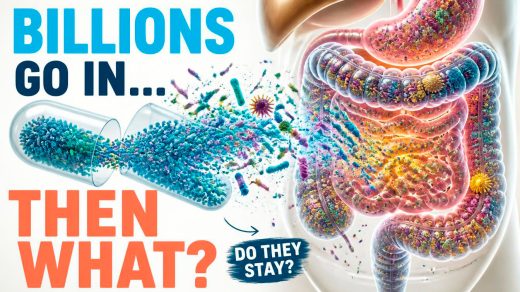

A stool sample can reveal remarkable details about your gut microbes. Turning those details into reliable, personalized food advice is a much harder scientific problem.
You mail a stool sample to a laboratory.
A few weeks later, an app gives you what looks like a remarkably personal map of your gut: lists of bacteria, abundance charts, perhaps a diversity score or microbes labeled favorable and unfavorable.
Then comes the part that feels most useful.
Eat more of this.
Eat less of that.
This food scores 87 for you. That one scores 42.
It can feel as though science has looked inside your gut and discovered the diet your body has been waiting for.
The first part of that process is real. Modern sequencing can extract enormous amounts of microbial information from stool.
The uncertainty begins when a report moves from what was detected to what it means—and then from what it means to what you should eat.
Those are three different scientific problems.
And right now, our ability to measure the microbiome is considerably more advanced than our ability to turn a single consumer stool sample into proven personalized dietary advice. An international expert consensus published in The Lancet Gastroenterology & Hepatology concluded that evidence supporting the clinical usefulness of microbiome testing remains scarce and that many direct-to-consumer tests are being offered without proven value in clinical practice.
So the important question is not whether a home test can find microbes in your stool.
It can.
The question is whether finding them reliably tells you what to eat.
A Microbiome Result Is a Measurement, Not Yet a Prescription
Most consumer gut tests analyze microbial genetic material in stool. Depending on the method, they may identify broad groups of bacteria or provide much more detailed information about microbial species and genes.
That is legitimate biological measurement.
But stool is still a sample. It does not provide a complete census of every microbial community throughout the digestive tract, and detecting microbial DNA does not automatically tell us exactly what those organisms were doing metabolically inside your gut.
More importantly, three steps tend to get compressed into one:
Measurement: We detected these microbial features.
Interpretation: We think this pattern means something about your health or diet.
Recommendation: Therefore, you should eat differently.
A laboratory can perform the first step reasonably well while the next two remain uncertain.
Even the measurement itself is not perfectly standardized across commercial services. A 2026 study sent standardized fecal material developed by the National Institute of Standards and Technology to seven direct-to-consumer microbiome-testing services. Researchers found major discrepancies both within and between providers; differences among companies were on a scale comparable with biological differences between stool donors.
That does not mean every result from every company is useless.
It means a dashboard displaying numbers to two decimal places may look more standardized than the underlying field actually is.
And measurement is the easier part.
There Is No Single “Healthy Microbiome” to Match
A personalized recommendation sounds straightforward if you imagine that researchers already know what the ideal gut microbiome looks like.
They do not.
Healthy people can have strikingly different microbial communities. Diet, geography, medications, age, intestinal conditions, environment, and many other factors contribute to that variation.
A 2025 Nature Reviews Microbiology perspective devoted specifically to the concept of a healthy microbiome concluded that defining one remains difficult because healthy microbial communities vary substantially across people, locations, and time.
That creates an obvious problem for statements such as:
Your bacterium X is too low.
Too low compared with whom?
And, more importantly, has raising it been shown to improve something that matters?
The same problem appears with microbial diversity. Diversity can be useful in research, and lower diversity has been associated with some diseases and disrupted states. But it is not a universal health score in which higher automatically means healthier.
So when a consumer report compares your microbiome with a proprietary reference population and labels part of it “imbalanced,” the interpretation requires more evidence than the colorful chart itself provides.
A microbial difference is real information.
It is not automatically a problem that needs correcting.
The Hardest Leap Is From “You Have This Microbe” to “Eat This Food”
Suppose people who regularly eat legumes tend to have more of a particular bacterium.
A report might appear to make a logical inference:
Legume eaters have more of this bacterium → you have less of it → therefore you should eat more legumes.
But observational relationships do not necessarily work backward that way.
Perhaps the diet caused the microbial pattern. Perhaps both are related to another lifestyle factor. Perhaps that organism behaves differently depending on the other microbes around it. And even if eating legumes reliably increases it, another question remains:
Would increasing that organism improve your health?
For a microbiome-based recommendation to become genuinely useful, a much longer chain needs to hold.
The microbial feature must be measured reliably.
It must help predict a response that matters.
That prediction must lead to a different dietary decision.
And following that test-guided decision should produce a better outcome than reasonable advice given without the microbiome result.
That last step is the one consumer reports can make look deceptively settled.
It isn’t.
Personalized Nutrition Is Real—But the Microbiome Is Usually Only One Input
There is genuine science behind personalized nutrition.
One landmark 2015 study followed 800 people and measured glucose responses to 46,898 meals. Responses varied substantially, including between people eating identical foods. Researchers built a machine-learning model using information about blood measurements, diet, body characteristics, physical activity, and gut microbiota to predict individual post-meal glucose responses. The model also performed in an independent validation group.
That was an important result.
It showed that microbiome information can contribute to a useful prediction.
But it did not show that a stool sample by itself reveals someone’s ideal diet.
The microbiome was one input among many, and the model predicted a very specific outcome: post-meal glucose response.
A later randomized trial in 225 adults with prediabetes tested a personalized diet generated using clinical and microbiome features against a Mediterranean-style diet. Both groups improved, while the personalized group showed larger improvements in some measures of glucose control.
Again, that is legitimate evidence for precision nutrition.
It is not evidence that a commercial stool test can identify universally “good” and “bad” foods for any healthy person.
The difference matters.
Predicting one defined response is not the same as discovering the best overall diet for an individual.
The Real Test Is Whether Using the Result Improves Health
This is where personalized microbiome advice faces its most important test.
Diet can change the microbiome.
Microbiome features can sometimes improve predictions.
But neither fact proves that using a stool test to choose someone’s foods produces better health.
A 2024 randomized trial in Nature Medicine illustrates both the promise and the limitation. Researchers compared standard US dietary advice with an 18-week personalized nutrition program in 347 adults. The personalized program incorporated food characteristics, post-meal glucose and triglyceride responses, health history, cardiovascular risk information, and microbiome data.
The personalized group achieved a modestly greater reduction in triglycerides and improvements in several secondary outcomes. LDL cholesterol, another primary outcome, did not differ significantly between groups.
That is encouraging evidence for a sophisticated personalized nutrition program.
It is much weaker evidence for the narrower claim:
“Send us your stool and we’ll tell you what to eat.”
The intervention used multiple biological inputs, dietary education, an app, and personalized food scores. The improvement cannot simply be assigned to the microbiome component.
That distinction is crucial.
If someone buys a microbiome-guided program, starts eating more vegetables, legumes, whole grains, and other nutrient-rich foods, and then improves a health marker, the result does not automatically prove that the stool analysis identified a uniquely appropriate diet.
Perhaps the personalization helped.
Perhaps improving the overall diet did most of the work.
To know which, researchers need studies designed to isolate the added value of microbiome information.
For ordinary consumers, that evidence remains limited.
A Precise Food Score Can Still Be Uncertain
One reason microbiome reports feel convincing is that they convert complex biology into exact-looking numbers.
Microbiome score: 74
Food A: 91
Food B: 38
Numbers feel objective.
But a precisely calculated score is not necessarily a clinically validated score.
To create one, a company has to decide which microbial features matter, choose a reference population, determine how those features relate to foods, combine them through an algorithm, and then translate the result into a recommendation.
The algorithm may calculate the score perfectly according to its own rules.
The scientific question is whether following that score leads to a better outcome.
The same caution applies to terms such as “good bacteria,” “bad bacteria,” and “dysbiosis.” Some microorganisms clearly matter in disease under particular circumstances. But the effects of many gut microbes depend on strain, abundance, location, neighboring organisms, diet, and the person hosting them.
Being different from a company’s reference microbiome is not, by itself, evidence that something is wrong.
And changing a microbial number is not automatically evidence that something became healthier.
How to Read a Microbiome Recommendation Without Giving It More Certainty Than It Has
The easiest way to make sense of a report is to ask what level of claim it is making.
A statement such as “we detected this organism” is primarily a measurement claim.
“This pattern has been associated with people who eat more of this food” is an association.
“This microbial pattern helps predict how you will respond” is a prediction—and becomes much more convincing if the model has been independently validated.
“Therefore you should eat this food” is a recommendation.
And the strongest claim would be:
People who use this test-guided recommendation achieve better health outcomes than comparable people who receive good dietary advice without the test.
That is the evidence that would establish real added value.
The farther a company travels from measurement toward prescription, the more evidence it should need.
That is why personalized and proven are not synonyms.
A highly individualized food score generated from dozens of microbial measurements can still be less certain than broad nutrition advice supported by decades of research.
The Technology Is Ahead of the Prescription
A small stool sample can now reveal an extraordinary amount of biological information.
That is a genuine scientific achievement.
Microbiome data are already helping researchers study metabolism, diet, disease, and individual differences. And well-designed personalized models that combine microbiome information with other biological and behavioral data may become increasingly useful.
But the hardest question starts after the sequencing is finished.
Finding a particular microbe does not automatically tell us whether you have the “right” amount of it.
Knowing that your microbiome differs from someone else’s does not tell us which one is healthier.
Knowing that a microbial pattern predicts one response does not prove that it can guide your entire diet.
And changing your microbiome does not automatically mean your health improved.
That leaves home microbiome testing in an unusual position: the report can contain genuinely personal biological information while the dietary prescription built on top of it remains much less certain.
So when a home test tells you what you should eat, the most useful question is not simply:
“Did the lab really find these bacteria?”
It is:
“Has using this information actually been shown to improve the dietary decision I’m being told to make?”
For most consumer microbiome-guided food advice, science cannot yet answer that question with the confidence the personalized score may imply.
We can already measure a remarkable amount about the gut microbiome. What we cannot yet do reliably is turn one stool sample into a proven personal menu.