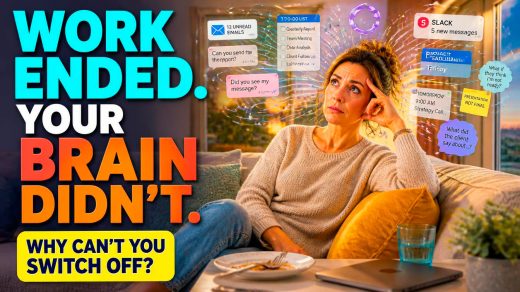

After a day of making choices, even deciding what to eat can feel like too much. But the popular idea that your brain simply runs out of decision-making energy isn’t as scientifically settled as it sounds.
You’ve made decisions all day.
You handled problems at work, responded to messages, rearranged appointments, and figured out which tasks needed your attention.
Some choices were important. Others barely registered.
Then evening arrives, and someone asks a harmless question:
“What should we have for dinner?”
Suddenly, you have nothing.
You don’t particularly care which option wins. You don’t want to compare restaurants, consider ingredients, or spend another five minutes discussing what sounds appealing.
You just want someone else to decide.
How can choosing dinner feel more exhausting than the important decisions you handled earlier?
The experience is often called decision fatigue.
The popular explanation is that every choice uses up a little of your brain’s limited decision-making energy. Make enough decisions, and eventually your mental battery runs low.
It’s an appealing idea. But research has raised serious questions about whether the brain actually works that way.
A more nuanced explanation is emerging: Making another decision can feel exhausting not simply because you’ve made too many choices, but because the mental effort required no longer feels worthwhile.
And sometimes, even a small decision demands more thinking than you’d expect.
Why a Small Decision Can Feel Surprisingly Difficult
We tend to judge how difficult a decision should be by how important its consequences are.
Choosing a new job seems difficult.
Choosing dinner seems easy.
But importance and mental effort aren’t the same thing.
Even a small decision can require you to compare options, recall preferences, consider trade-offs, and decide which differences actually matter.
When one option clearly stands out, that process happens almost effortlessly.
When several options seem equally acceptable—or equally unappealing—it can become surprisingly tedious.
Imagine you’re genuinely craving pizza.
Dinner is easy.
Now imagine nothing sounds particularly appealing.
You consider pizza, pasta, takeout, or cooking something at home. Every option has advantages, but none feels worth choosing.
You keep comparing without getting any closer to a decision.
The stakes are low, but the mental work keeps going.
Psychological research helps explain why.
In a 2015 meta-analysis published in the Journal of Consumer Psychology, researchers examined 99 research observations involving 7,202 participants to understand choice overload—the difficulty people sometimes experience when faced with numerous alternatives.
They found that having more options wasn’t automatically a problem.
What mattered included how complicated the choices were, how difficult they were to compare, and how uncertain people felt about their preferences.
The desire to minimize effort also influenced whether having more options became overwhelming.
That last finding is particularly relevant to the dinner problem.
When you already know what you want, more choices may be welcome.
When you don’t know what you want—and would rather not spend much effort figuring it out—even a handful of alternatives can become frustrating.
However, choice overload and decision fatigue aren’t identical.
Choice overload concerns the difficulty of evaluating alternatives. Decision fatigue concerns the experience of finding further choices increasingly demanding after sustained mental effort.
Research on one doesn’t automatically prove the other.
But it reveals something important:
A decision doesn’t have to be important to require substantial mental effort.
And after a demanding day, the prospect of making another effortful comparison may feel particularly unwelcome.
Does Your Brain Really Run Out of Decision-Making Energy?
For years, one influential psychological theory offered a straightforward explanation for this experience.
It suggested that self-control operates like a limited resource.
Every time you resist an impulse, maintain concentration, or complete a demanding self-control task, you consume some of that resource.
Eventually, less remains available for whatever comes next.
Psychologists called this proposed phenomenon ego depletion.
The theory seemed to explain why people might struggle with choices after a mentally demanding day.
They had simply used up their available willpower.
But when scientists tried to reproduce the effect in large, carefully planned experiments, the results became much less convincing.
In 2016, researchers coordinated a preregistered replication project across 23 laboratories involving 2,141 participants.
Participants completed tasks designed to test whether exerting self-control on one activity would reduce performance on another.
The combined results showed an extremely small estimated effect, with statistical uncertainty that included no effect at all.
A second major project, published in Psychological Science in 2021, tested the theory across 36 laboratories and 3,531 participants.
Its preregistered primary analysis again failed to find statistically significant evidence of the predicted depletion effect.
These findings challenged the idea that mental effort consistently drains a fixed supply of self-control.
But the scientific debate hasn’t ended completely.
Another preregistered multilaboratory experiment involving 1,775 participants reported a small but statistically significant depletion effect.
And laboratory self-control tasks aren’t perfect replicas of the countless decisions people make during everyday life.
So the research doesn’t justify claiming that decision fatigue has been disproven.
It supports a more careful conclusion:
Mental effort can feel genuinely exhausting, but scientists haven’t established that each decision depletes a fixed supply of willpower.
There’s no proven mental battery that loses a little charge every time you choose something.
Nor is there a universal rule that every decision must become harder as the day progresses.
That leaves us with a more interesting possibility.
What if the problem isn’t simply how much mental energy remains—but how worthwhile another decision feels?
What If Your Brain Decides the Effort Isn’t Worth It?
Return to the dinner question.
You understand the options perfectly well.
You remember what you like. You could compare the restaurants, check the prices, and settle on something reasonable.
You aren’t necessarily incapable of choosing.
You just don’t want to spend more mental effort on the decision.
Researchers have proposed that this feeling may be connected to how the mind evaluates the costs and benefits of continued thinking.
In a 2013 paper published in Behavioral and Brain Sciences, psychologist Robert Kurzban and colleagues introduced an opportunity cost model of mental effort.
The idea is that attention and mental control are valuable because they could be devoted to different activities.
When you concentrate on one task, you aren’t using that same attention for something else.
Your mind may therefore evaluate whether continuing to invest effort is worth what the task offers in return.
This is a theoretical model, not a proven explanation for every experience of decision fatigue.
But it offers a useful perspective.
Imagine spending the afternoon making decisions that genuinely matter.
You resolve an urgent problem, deal with conflicting responsibilities, and make choices that have real consequences.
Those decisions may deserve careful attention.
Now someone asks you to choose between three equally acceptable dinners.
You could spend another ten minutes comparing them.
But what would that additional effort accomplish?
Probably very little.
The difference between choosing pasta and ordering pizza might not be important enough to justify another round of deliberation.
The decision hasn’t necessarily become more difficult. The effort of making it may simply feel less worthwhile.
That distinction matters.
Feeling reluctant to keep thinking isn’t identical to losing the ability to think.
Someone may still be capable of making a perfectly reasonable choice while finding the process unusually tiring or unpleasant.
Of course, sustained mental demands can affect attention and performance too. Researchers continue investigating how cognitive fatigue, motivation, and mental control interact.
The opportunity cost model doesn’t explain every situation, and no single theory accounts for all experiences of mental fatigue.
But it helps explain why small decisions can feel disproportionately exhausting.
Sometimes the problem isn’t understanding the alternatives.
It’s having to evaluate them at all.
Why Simplifying a Decision Can Make It Feel Easier
Suppose you’re staring at six dinner options.
None stands out. You keep comparing prices, convenience, and what you might enjoy.
Every additional consideration makes the decision feel more complicated.
But what if only two options actually meet what you need?
Suddenly, the choice becomes easier to evaluate.
You haven’t necessarily restored some depleted supply of mental energy.
You’ve reduced the amount of comparison required.
This fits with research showing that decision difficulty depends partly on the complexity of the alternatives and uncertainty about preferences.
When fewer considerations genuinely matter, there’s often less work involved in choosing.
That doesn’t mean fewer options are always better.
Sometimes more choices help people find something they genuinely prefer.
And simplifying decisions hasn’t been established as a universal treatment for decision fatigue.
But it points toward a useful distinction: not every decision deserves the same amount of thought.
Choosing whether to accept a major job offer may justify careful deliberation.
Choosing between two equally acceptable dinners usually doesn’t.
If further comparison is unlikely to produce a meaningfully better outcome, a satisfactory choice may be sufficient.
That isn’t evidence of impaired judgment. It can simply be a reasonable way to avoid spending unnecessary effort.
There is also no scientific rule that everyone must make important decisions in the morning because their decision-making ability inevitably deteriorates throughout the day.
Sleep, sustained mental demands, the complexity of the task, and individual circumstances can all affect how difficult choosing feels.
Occasional late-day indecision is common. Persistent or unusually severe difficulty making ordinary decisions, especially when it interferes with everyday life, may deserve discussion with a healthcare professional.
But the familiar experience of not wanting to choose dinner after a demanding day doesn’t automatically suggest anything is wrong.
So Why Do Small Decisions Feel So Exhausting?
Think back to the end of that busy day.
You’ve handled important responsibilities, solved problems, and made countless choices.
Then someone asks what you want for dinner.
The consequences are minor.
You understand the options.
Yet another round of comparing, weighing, and choosing feels like more than you want to deal with.
The familiar explanation is that you’ve exhausted your daily supply of decision-making energy.
But the research doesn’t establish such a simple mechanism.
Small decisions can require more thought than their importance suggests. Sustained mental demands can make further effort feel unpleasant. And the perceived value of continuing to deliberate may influence whether another choice feels worthwhile.
That doesn’t mean decision fatigue is imaginary.
It means feeling exhausted by decisions isn’t proof that your brain has run out of the ability to make them.
Sometimes the most exhausting part of a small choice isn’t its difficulty.
It’s being asked to invest more thought in a decision that barely seems worth thinking about.