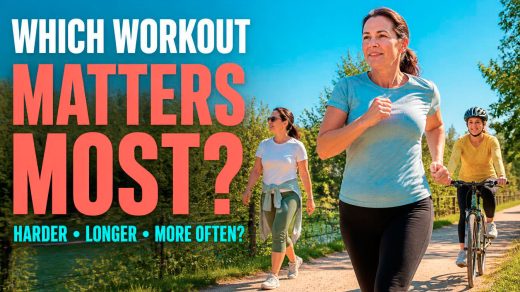

Walking can be light everyday movement, moderate-intensity exercise, or a genuinely demanding workout. What matters is not the label—it’s the dose.
You walk for 30 minutes most days. Then someone asks how often you exercise, and you hesitate.
“Well, I walk.”
As if walking belongs in a lesser category than running, cycling, lifting weights, or going to the gym.
Physiologically, that distinction doesn’t make much sense. A slow stroll through a store, a purposeful brisk walk, and 45 minutes of climbing hills are all “walking.” They are not remotely the same exercise stimulus.
So the useful question isn’t whether walking counts.
It’s how much demand your walking places on your body—and whether that dose is enough for the health or fitness goal you care about.
For many adults, regular walking can provide substantial health benefits. Brisk walking can count directly toward U.S. aerobic-activity recommendations. And for someone who is mostly inactive, simply walking more may be one of the most valuable changes available.
But walking is not automatically a complete fitness program.
That distinction—between walking being valuable and walking being everything you need—is where the answer gets interesting.
Yes, Walking Can Absolutely Count as Exercise
U.S. physical-activity guidelines recommend that adults get 150 to 300 minutes of moderate-intensity aerobic activity each week, or 75 to 150 minutes of vigorous activity, or an equivalent combination.
Brisk walking is specifically included as moderate-intensity aerobic activity.
And those minutes do not have to happen inside a gym or even during something you think of as a “workout.” A brisk walk to work, around your neighborhood, or during lunch can contribute just as legitimately.
The body responds to physical demand, not to whether you changed into workout clothes first.
The catch is that not every walk creates the same demand.
The Important Question Is: How Hard Are You Walking?
Imagine two people walking side by side at exactly the same speed.
One is a trained distance runner. The other has recently started exercising after years of little activity.
Same pace. Very different workout.
This is why exercise guidelines often use relative intensity—how demanding an activity is for you—rather than one universal walking speed.
Fitness matters. So do hills, terrain, and other conditions.
One of the simplest ways to estimate effort is the talk test. During moderate-intensity activity, you can generally talk, but singing would be difficult. During vigorous activity, getting out more than a few words at a time becomes harder.
That makes “brisk walking” more useful than prescribing one exact pace.
If your breathing is noticeably elevated but you can still carry on a conversation, your walk may be providing a moderate aerobic stimulus.
If you are strolling comfortably below that level, the walk still matters. Light movement adds activity to a day that might otherwise contain a lot of sitting. And for someone starting from very little movement, that increase can be especially meaningful.
The mistake is treating walking as one fixed intensity.
It isn’t.
What Can Regular Walking Actually Improve?
Walking’s accessibility sometimes makes it sound less potent than more dramatic forms of exercise. Controlled trials suggest otherwise.
A systematic review and meta-analysis of randomized trials in previously inactive adults found that walking programs improved aerobic fitness and produced modest average improvements in blood pressure, body weight, waist circumference, and body fat.
Walking can also affect glucose regulation. Research suggests that activity after meals, including walking, can reduce post-meal glucose rises. That short-term effect should not be inflated into a claim that a particular walking schedule prevents diabetes, but it shows that even ordinary movement can produce measurable metabolic effects.
Walking interventions have also been associated with improvements in depressive and anxiety symptoms. That does not make walking a substitute for mental-health treatment when treatment is needed. It does mean its potential benefits extend beyond cardiovascular fitness.
And walking can help maintain mobility and everyday physical function—outcomes that become increasingly important with age.
The size of these benefits varies. Someone who is currently inactive has much more room to adapt than someone who is already highly fit.
That turns out to be one of walking’s biggest advantages.
The Biggest Benefit May Come From Simply Moving More
Suppose one person increases from 3,000 steps a day to 5,000.
Another increases from 12,000 to 14,000.
Both added 2,000 steps, but we should not assume the health effect is identical.
Physical-activity research repeatedly finds a nonlinear relationship between activity and health: some of the largest relative gains appear when people move away from very low activity levels. Benefits can continue as activity increases, but the curve generally becomes less steep.
That helps explain why walking matters so much from a public-health perspective.
It is not necessarily the most intense exercise. It is an activity many people can actually repeat.
A theoretically superior workout has limited value if it rarely happens. A walk that fits into everyday life can accumulate into hours of movement across a week.
Consistency does not make every exercise dose equivalent.
It determines whether the dose happens at all.
And No, You Don’t Need Exactly 10,000 Steps
The 10,000-step goal has become so familiar that it can sound like a biological threshold.
It isn’t.
A 2022 meta-analysis of 15 cohorts found progressively lower mortality risk as daily steps increased, with the relationship leveling off at roughly 6,000 to 8,000 steps a day among adults 60 and older and 8,000 to 10,000 among younger adults.
A broader 2025 systematic review found meaningful associations between daily steps and multiple health outcomes, again with substantial benefits appearing below 10,000 steps for many outcomes.
That does not mean everyone should replace 10,000 with another supposedly perfect number.
These studies were largely observational, different health outcomes produced different curves, and individuals begin at different activity levels.
There is also something a step count cannot tell you very well: how hard those steps were.
Two people can each record 8,000 steps. One may accumulate them through easy movement throughout the day. The other may include 40 minutes of brisk uphill walking.
Same total. Different aerobic stimulus.
Steps are useful for measuring movement volume.
They are not a complete measure of exercise.
Does Walking Faster Make It “Better”?
Walking faster generally increases cardiovascular demand, which can make a walk more time-efficient as aerobic exercise.
But faster is not automatically better in every situation.
Observational studies find that faster habitual walking pace is associated with lower cardiovascular and mortality risk. Yet part of that relationship may run in the opposite direction: people who are healthier and fitter may simply be capable of walking faster.
Controlled exercise research gives us firmer ground for a simpler conclusion: increasing aerobic intensity generally creates a stronger cardiorespiratory training stimulus.
Whether that is desirable depends on the goal.
A slower pace may let someone walk longer, recover more easily, experience less discomfort, or enjoy the activity enough to keep doing it.
Exercise always involves trade-offs among intensity, volume, tolerability, and consistency.
The hardest walk is not automatically the most useful walk.
The Same Walk Can Become Less of a Workout
There is another reason walking intensity cannot be defined by speed alone: your fitness changes.
For someone who has been mostly inactive, 30 minutes of brisk walking may initially be challenging enough to improve aerobic fitness.
Months later, the same route at the same pace may feel easy.
That doesn’t mean walking “stopped working.”
It means the body adapted.
If the goal is general movement and health, an easier walk may still be valuable. But if the goal is continued improvement in aerobic fitness, the stimulus may eventually need to progress.
That could mean walking faster, extending the route, adding hills, including brisk intervals, or switching some sessions to another activity.
A highly trained endurance athlete and a sedentary beginner can take the same walk and receive very different training effects.
That is why the question “Is walking enough?” cannot be answered without asking:
Enough for whom—and enough for what?
Where Walking Alone Leaves Gaps
For general aerobic activity, walking can cover a lot.
For complete fitness, there are important things it may not cover.
Strength is the clearest gap
U.S. guidelines recommend muscle-strengthening activity on at least two days per week in addition to aerobic activity.
Ordinary walking certainly uses your muscles, and hills or stairs increase the challenge. But once your body is accustomed to walking, it usually does not provide much progressive resistance for many major muscle groups, particularly in the upper body.
So someone can meet the entire aerobic recommendation through brisk walking and still benefit from strength training.
Bone health is more complicated
Walking is weight-bearing, but “weight-bearing” does not automatically mean it provides the strongest bone-building stimulus.
Research in postmenopausal women suggests that walking alone may offer modest benefits at some skeletal sites while doing relatively little at others. Resistance exercise and appropriately selected higher-loading activities can provide a different stimulus to bone.
That does not mean everyone should start jumping or doing high-impact exercise. Appropriate activity depends on health, ability, injury history, and other individual factors.
It simply means walking does not provide every kind of physical challenge the body can benefit from.
High-end aerobic fitness eventually requires more
As fitness rises, ordinary level walking may no longer push the cardiovascular system very hard.
For a beginner, brisk walking can be a substantial workout.
For a well-trained athlete, it may be active recovery.
If your goal is to maximize aerobic capacity or athletic performance, you will eventually need enough intensity to continue challenging your current fitness level.
Again, walking has not failed.
You have outgrown that particular dose.
Don’t Judge Walking Only by Weight Loss
Walking burns energy, and randomized walking interventions have produced modest average reductions in body weight and body fat.
But whether someone loses weight depends on much more than the calories used during a walk. Food intake, appetite, body size, medications, other activity, and many other factors can influence the outcome.
So walking more does not guarantee substantial weight loss.
More importantly, lack of weight loss does not mean the walking was pointless.
Aerobic fitness can improve.
Blood pressure can improve.
Glucose responses can change.
Mobility can improve.
Someone may feel and function better while the scale barely moves.
Body weight is therefore a poor pass-or-fail test for whether exercise is doing anything useful.
How to Make Walking Do More—If You Want It To
You do not need to turn every walk into a training project.
But if you want walking to provide more exercise stimulus, there are several levers you can adjust.
You can walk more often, walk longer, increase the pace, choose more challenging terrain, or gradually add hills or brisk intervals.
You do not need to increase everything at once.
And if your current walking routine already gives you the activity, enjoyment, and health benefits you want, there is no evidence-based requirement to make it harder simply for the sake of optimization.
Progression matters when progress is the goal.
For someone with significant mobility limitations, symptoms during exertion, or medical conditions that affect exercise, progression may need to be individualized rather than based on a generic walking target.
So, Is Walking Enough?
It depends entirely on what you mean by enough.
If you are mostly inactive: walking is an excellent place to start. Some of the largest relative health gains occur when people move from very little activity to more.
If you want to meet aerobic-activity guidelines: brisk walking can absolutely do it. Accumulate enough moderate-intensity walking across the week, and it counts.
If your goal is general health: regular walking has credible evidence behind it, including benefits for aerobic fitness and cardiovascular risk factors, while higher daily step counts are consistently associated with better long-term health outcomes.
If you want a well-rounded fitness routine: walking alone leaves gaps, particularly in muscle strengthening.
If you want to maximize aerobic fitness or athletic performance: ordinary walking will usually become insufficient as your fitness improves.
Those answers are not contradictory.
“Enough exercise” only makes sense once you define the outcome.
Walking Doesn’t Have to Look Like a Workout to Work
Return to that 30-minute daily walk.
Maybe it is easy and mainly adds movement to your day.
Maybe it is brisk enough to count toward your weekly moderate-intensity exercise.
Maybe the route climbs hills and leaves you breathing hard.
Calling all three “walking” hides more than it explains.
Your body responds to how hard you work, how long you do it, how often you repeat it, and how challenging that effort is for your current fitness.
Walking does not need to replace every other form of exercise to deserve the label “real exercise.” Its limits are real: it does not automatically provide progressive strength training or indefinitely challenge aerobic fitness.
But its simplicity is also part of its power. Walking is accessible enough to turn exercise from something many people plan to do into something they can actually repeat.
So yes, walking counts.
The better question is: What is your walking doing for you—and is that enough for what you want it to do?