
The point of preserving muscle with age is not to stay big, lean, or young-looking. It is to keep ordinary life from becoming physically demanding.
Getting out of a low chair. Carrying groceries upstairs. Lifting a suitcase into a car. Catching yourself after an awkward step.
None of these looks like a fitness test.
But every one of them depends on having enough physical capacity in reserve.
When you are strong enough, the task barely registers. When that reserve shrinks, the same task starts asking for a much larger share of what your body can do.
That is the most useful way to understand why muscle matters with age.
Not because everyone needs large muscles.
Not because muscle mass is a longevity score.
But because skeletal muscle helps determine how much effort ordinary life requires—and how much capacity you have left when something goes wrong.
Muscle Size Is Only Part of the Story
“Losing muscle” sounds like one problem. In reality, several different capacities can change with age.
Muscle mass is how much skeletal muscle tissue you have.
Strength is how much force you can produce.
Power is how quickly you can produce that force.
Physical function is what all of this allows you to do: walk, climb stairs, stand from a chair, carry objects, recover your balance, and move through daily life.
These things are related, but they are not interchangeable.
One of the important findings in aging research is that strength can decline faster than muscle mass. Longitudinal studies have found that older adults can lose substantial strength even when changes in lean mass are relatively modest.
That makes sense. Producing force depends on more than the amount of muscle tissue present. It also depends on the nervous system, muscle quality, coordination, fiber characteristics, and how effectively the muscle is recruited.
So a body-composition scan can tell you something.
It cannot tell you everything about what your body can actually do.
The Real Issue Is Physical Reserve
Imagine that getting out of your favorite chair requires 30 units of leg force.
If your maximum capacity is 100, the task uses only a small fraction of what you have.
If your capacity falls to 50, the chair has not changed—but now the same movement requires much more of your maximum.
That is reserve.
The larger the gap between what daily life demands and what you are capable of doing, the easier ordinary tasks feel.
As that gap narrows, small changes start to matter more.
A heavy grocery bag becomes worth splitting into two trips.
A staircase starts to require planning.
A brief illness or week of inactivity can have a bigger effect.
This is why physical function often matters more than a single muscle-mass number. Large observational studies consistently link lower strength with greater difficulty in activities such as walking, dressing, bathing, and transferring.
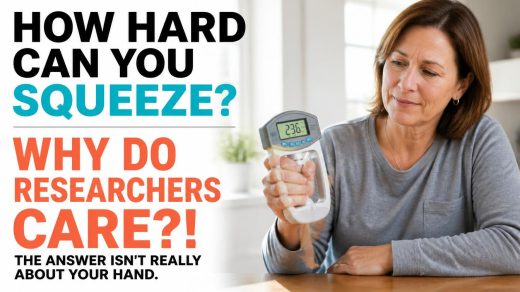
Grip strength is sometimes called a “longevity biomarker” because lower grip strength is also associated with higher mortality risk.
But that phrase can be misleading.
Grip strength is a predictor, not a guarantee. Low strength may reflect many other things at once—lower activity, chronic illness, frailty, poor nutrition, neurological disease, or broader loss of physical capacity.
Its real value is that it captures something muscle size alone misses:
Can the body generate useful force?
Power Matters Because Life Sometimes Happens Fast
Strength answers one question:
How much force can you produce?
Power adds another:
How quickly can you produce it?
That difference matters in surprisingly ordinary moments.
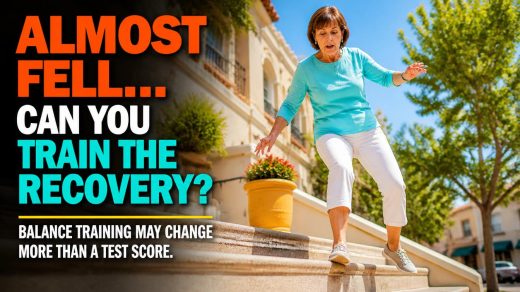
Standing up quickly. Climbing a step. Correcting a stumble. Moving your foot fast enough to regain balance.
Research suggests that muscle power often declines earlier and faster with age than maximal strength and is strongly related to physical function.
That does not mean every older adult should begin explosive training.
It means that muscle is most useful when it can produce enough force at the moment life requires it.
Having tissue is one thing.
Being able to use it effectively is another.
Illness Reveals Why Reserve Matters So Much
The idea becomes especially clear during periods of forced inactivity.
Muscle and strength can decline much faster during bed rest, hospitalization, or illness than during normal day-to-day aging.
In controlled studies, even short periods of bed rest have reduced lower-body lean tissue, strength, and insulin sensitivity.
Real illness is more complicated than a laboratory bed-rest experiment. Inflammation, reduced food intake, medications, and disease severity can all affect recovery.
But the principle is useful:
If two people lose the same amount of capacity, the one who started with more reserve may still remain above the level needed for independent daily tasks.
The person who started closer to that threshold may cross it.
That does not mean muscle can be “banked” as protection against every future illness.
It means where you start can influence how disruptive a setback becomes.
Muscle Also Matters Metabolically—But It Is Not a Magic Organ
Skeletal muscle is not only mechanical equipment.
It is also a major site for glucose storage and disposal and plays an important role in whole-body metabolism. Muscle contractions can increase glucose uptake, and resistance training can improve insulin sensitivity and other metabolic measures in some populations.
That is one reason maintaining active muscle matters beyond strength.
But this biology is easy to oversell.
Calling muscle a “longevity organ” can imply that simply having more of it protects against metabolic disease.
It does not work that way.
Cardiovascular disease, type 2 diabetes, and other age-related conditions depend on many interacting factors, including genetics, body fat, diet, smoking, sleep, medications, blood pressure, and physical activity.
Muscle is metabolically important.
It is not a force field against aging.
Can You Actually Preserve Strength With Age?
Aging changes muscle.
It does not make adaptation impossible.
Older adults remain highly responsive to resistance exercise, and the evidence here is unusually strong.
Large reviews show that resistance training can improve strength, muscle size, power, gait speed, balance, and multiple measures of physical function.
That does not mean everyone needs barbells or a bodybuilding program.
Resistance can come from machines, free weights, bands, body-weight exercises, and other forms of progressively challenging muscular work.
The key idea is progressive resistance.
Muscle needs a reason to adapt.
If an exercise remains easy forever, it provides less reason for the body to become stronger.
And meaningful improvement remains possible later in life.
Age changes the response.
It does not erase it.
Walking Helps—but It Solves a Different Problem
Walking, cycling, swimming, and other aerobic activities are also central to healthy aging.
They support cardiorespiratory fitness, endurance, mobility, and metabolic health.
But ordinary walking usually does not provide the same progressive muscular loading as resistance training.
That is why U.S. physical-activity guidance recommends both:
- aerobic activity;
- and muscle-strengthening activity on at least two days each week.
For older adults, balance-focused activity is also encouraged.
The point is not that the exact number of days creates a biological threshold.
It is that aerobic and resistance exercise produce overlapping but different adaptations.
A person can have excellent endurance and still lack enough strength for certain tasks.
Another can be strong but become breathless quickly.
Healthy aging benefits from more than one kind of reserve.
Nutrition Helps Muscle Adapt—but Protein Is Not the Whole Answer
Muscle needs building material as well as training.
Protein supplies amino acids used in muscle-protein turnover, and inadequate protein or inadequate total energy can make muscle preservation more difficult.
Some expert groups and research reviews suggest that older adults may benefit from protein intakes above the standard adult reference level in certain circumstances, especially alongside resistance exercise.
But protein does not replace the training stimulus.
Recent evidence continues to support that distinction: resistance training itself improves strength and physical function, while adding protein can provide further benefits for some outcomes, particularly muscle mass, depending on baseline intake and population.
The useful relationship is:
exercise gives muscle a reason to adapt; nutrition helps support that adaptation.
A supplement alone does not reproduce the effect of progressive training.
Is Strength Training More Important Than Cardio?
That question assumes healthy aging has only one job.
It does not.
Resistance training is particularly effective for strength and muscle.
Aerobic training is particularly effective for cardiorespiratory fitness and endurance.
Both can support metabolic health and physical function.
Neither completely replaces the other.
So the better question is not:
Weights or cardio?
It is:
Which capacity do I need more of?
If climbing stairs leaves you breathless, aerobic fitness may be the limiting factor.
If you can walk for an hour but struggle to stand from a low chair, strength may matter more.
If balance is becoming uncertain, that deserves attention too.
A well-rounded aging strategy is less about choosing the “best” exercise and more about preserving the capacities daily life actually uses.
What About Sarcopenia?
“Sarcopenia” is often used casually to mean losing muscle with age.
Clinically, it is more specific.
Professional groups define it somewhat differently, but modern frameworks increasingly emphasize low muscle strength, not muscle mass alone.
The European Working Group on Sarcopenia in Older People, for example, places low strength at the center of case identification, then uses low muscle quantity or quality to confirm the diagnosis and poor physical performance to indicate greater severity.
That shift in thinking is revealing.
Researchers increasingly recognize that the amount of muscle a person has does not fully tell us whether that muscle is useful.
This is also why a smart scale, mirror, or single grip-strength measurement cannot diagnose sarcopenia on its own.
The important change in perspective is simpler:
what muscle can do matters at least as much as how much of it exists.
The Goal Is Not to Stay as Strong as You Were at 25
Healthy-aging advice can easily turn into a competition with your younger self.
That is neither necessary nor realistic.
Aging well does not require preserving the exact sprint speed, lifting ability, recovery rate, or muscle mass of early adulthood.
The more useful goal is maintaining enough capacity to keep doing what matters to you.
Travel.
Garden.
Play with family.
Carry groceries.
Climb stairs.
Get off the floor.
Continue a sport.
Recover from illness and return to ordinary life.
And when physical capacity changes, adaptation still counts.
A handrail can preserve access to stairs.
A mobility aid can expand rather than shrink someone’s world.
Rehabilitation can restore lost function.
Healthy aging is not defined by refusing help.
It is about preserving participation.
A Better Way to Think About Muscle and Aging
Muscle matters most when you stop thinking about it as a body-composition goal.
Think function before appearance.
Strength matters because it helps you stand, lift, carry, balance, and move.
Think reserve rather than perfection.
Daily tasks stay easy when they use only a modest fraction of your available capacity.
Think strength and size separately.
More muscle can be useful, but muscle quantity alone does not tell you how much force or power you can produce.
Think across capacities.
Resistance exercise, aerobic exercise, and balance training solve different pieces of the healthy-aging problem.
And think trajectory rather than one number.
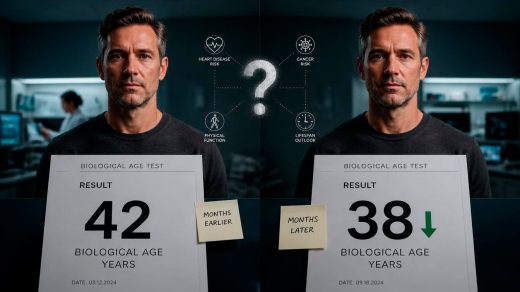
A noticeable decline in walking speed, chair-rise ability, strength, or everyday function may tell you more than a small change on a body-composition scan.
The real question is not:
How much muscle should an older person have?
It is:
What do I want this muscle to keep allowing me to do?
Muscle Matters Because Life Is Physical
Return to those ordinary movements.
Standing from a chair.
Carrying groceries.
Climbing stairs.
Recovering from a stumble.
Getting off the floor.
They are easy to ignore while they remain easy.
But each depends on a combination of muscle, strength, power, coordination, balance, and endurance.
That is why muscle has become so central to healthy-aging research.
Not because aging well requires looking muscular.
Not because muscle mass alone predicts how long you will live.
And not because resistance training can prevent every age-related decline.
Muscle matters because it helps create the reserve that separates:
“I can do this without thinking”
from
“This has become difficult.”
That is a much more useful goal than simply trying to stay young.
The most important reason to preserve muscle with age is not to look younger—it is to keep ordinary life physically within reach.