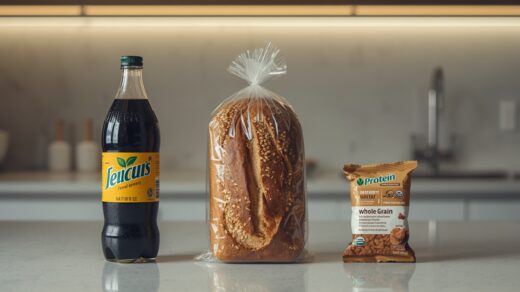

Getting enough fiber matters. But “fiber” is not one substance with one effect—and two diets with the same number of grams can behave very differently in the body.
Imagine two people who each eat 30 grams of fiber a day.
One gets most of it from oats, beans, berries, vegetables, nuts, and whole-grain bread. The other gets the same 30 grams largely from fiber-fortified cereal, snack bars, drinks, and a few added fiber ingredients.
On a nutrition tracker, the totals match.
Inside the body, they may not.
Different fibers absorb water differently, form gels differently, resist digestion differently, and are fermented by gut microbes to different degrees. Those properties help determine whether a fiber mainly affects stool consistency, LDL cholesterol, post-meal blood glucose, or microbial activity in the colon.
So “eat more fiber” is good advice—but incomplete advice.
A better way to think about it is:
Amount matters. Type matters. And the food carrying the fiber matters too.
Most Americans Still Aren’t Getting Enough
U.S. Dietary Reference Intakes base fiber recommendations on about 14 grams for every 1,000 calories consumed.
That translates into commonly cited daily targets of about:
- 38 grams for men ages 19–50 and 30 grams after age 50;
- 25 grams for women ages 19–50 and 21 grams after age 50.
Those age-based numbers mostly reflect differences in estimated energy needs, not a sudden drop in fiber requirements after a particular birthday.
For Nutrition Facts labels, the FDA uses 28 grams as the Daily Value on a 2,000-calorie diet.
Many Americans fall well short of those amounts.
That matters because higher-fiber eating patterns are consistently associated with better long-term health. Large reviews have linked greater fiber intake with lower risks of coronary heart disease, stroke, type 2 diabetes, colorectal cancer, and premature death.
But fiber does not suddenly become useful when you hit a particular number.
The more important point is that chronically low intake leaves a lot of room for improvement.
And once quantity is reasonably adequate, the next question becomes more interesting:
What kind of fiber are those grams actually coming from?
“Soluble” and “Insoluble” Don’t Tell the Whole Story
You may have learned that fiber comes in two categories:
Soluble fiber dissolves in water. Insoluble fiber does not.
That distinction is real. It is also too crude to predict everything fiber does in the digestive tract.
Several other properties matter.
Viscosity describes whether a fiber thickens and forms a gel.
Fermentability describes how readily gut microbes can break it down.
Water-holding and bulking capacity affect stool volume and consistency.
These properties often matter more than the simple soluble-insoluble label.
Psyllium, for example, is soluble and highly viscous. It forms a gel and has evidence for both bowel regulation and LDL-cholesterol reduction.
Oat beta-glucan is also viscous and can lower LDL cholesterol.
Inulin is readily fermented by gut microbes but behaves very differently from psyllium.
Coarse wheat bran is poorly fermented and works more through water retention and physical bulking.
So instead of asking whether a fiber is merely soluble or insoluble, a more useful question is:
What does this particular fiber actually do?
Different Fibers Solve Different Problems
The differences become clearer when you organize fiber by outcome rather than by category.
For bowel regularity
Fiber can help constipation, but not every fiber works the same way.
Some fibers hold water and increase stool bulk. Others form gels that can soften hard stool while also giving loose stool more form. Highly fermentable fibers may be broken down so extensively by microbes that they contribute relatively little physical bulk.
A 2022 meta-analysis of 16 randomized trials involving more than 1,200 adults with chronic constipation found that fiber supplementation improved bowel movement frequency and stool consistency overall, with particularly supportive evidence for psyllium. Flatulence also increased.
The practical lesson is not that everyone with constipation should take psyllium.
It is that fiber’s physical properties matter.
A fiber that microbes rapidly ferment is not automatically the same tool as one that stays intact long enough to hold water and add bulk.
For LDL cholesterol
This is one of the clearest examples of fiber type making a difference.
Highly viscous fibers such as psyllium and beta-glucan can form gels in the small intestine. That interferes with the normal recycling of bile acids, prompting the liver to use more cholesterol to replace them.
Randomized-trial meta-analyses have consistently found modest LDL reductions from certain soluble, viscous fibers.
But “soluble fiber lowers cholesterol” is too broad.
Some soluble fibers create little viscosity and do not produce the same effect.
The important property is not simply that the fiber dissolves.
It is what happens after it does.
For blood glucose and fullness
Viscous fibers can also slow the movement and absorption of nutrients, which can reduce the size of the blood-glucose rise after a carbohydrate-containing meal.
That is a real physiological effect.
But lowering a post-meal glucose spike is not the same as lowering long-term HbA1c or preventing type 2 diabetes. Those are different outcomes that require longer-term evidence.
Fiber is also often described as automatically filling.
Sometimes it is. But satiety depends on more than fiber grams alone: food volume, texture, chewing, viscosity, energy density, and the surrounding meal all matter.
Five grams of added fiber in a snack bar does not necessarily create the same eating experience as beans, whole fruit, or intact grains.
Then There’s the Microbiome
Some fibers travel through the small intestine largely undigested and reach the colon, where gut microbes can ferment them.
That process can produce gases and compounds such as short-chain fatty acids, and it can alter microbial activity.
But “fiber feeds good bacteria” is too simple.
Different fibers are fermented at different rates and by different microbial pathways. People also have different microbial communities to begin with, so the same fiber may not produce the same response in everyone.
This is also where the word prebiotic is often used too loosely.
A prebiotic is not simply any fiber that microbes can ferment. The scientific definition requires a substrate to be selectively used by host microorganisms and to confer a health benefit.
That final part matters.
A rise in a bacterial group or a microbial metabolite may be scientifically interesting without proving that the person is healthier.
So fiber can influence the microbiome.
But microbiome change is not automatically health improvement.
Whole-Food Fiber and Added Fiber Aren’t Opposites
It is tempting to turn the issue into another “natural versus processed” debate.
The evidence does not support such a simple split.
Whole foods rich in fiber bring more than fiber.
Beans provide protein, minerals, resistant carbohydrates, and an intact food structure.
Nuts provide unsaturated fats and micronutrients.
Fruit brings water, vitamins, phytochemicals, and plant tissue.
Whole grains contain fiber alongside minerals and other compounds.
That means a fiber-rich whole-food diet can have benefits that are difficult to attribute to fiber alone.
But isolated or added fiber is not automatically inferior.
The FDA allows certain isolated and synthetic nondigestible carbohydrates to count as dietary fiber when evidence shows a beneficial physiological effect. Psyllium, beta-glucan, cellulose, guar gum, and pectin are among examples with recognized uses.
Some added fibers have unusually good evidence for specific outcomes.
Psyllium can help lower LDL cholesterol and improve stool consistency.
Beta-glucan can lower LDL when it retains enough viscosity.
Other added fibers may have very different effects.
So the useful distinction is not:
whole-food fiber = good
added fiber = bad
It is:
What has this fiber been shown to do—and what else does the food containing it contribute?
A snack bar with added fiber can legitimately increase fiber intake.
That does not mean the fiber automatically makes every other feature of the bar nutritionally ideal.
Why Total Fiber Still Matters
If different fibers behave differently, why do guidelines give us one total-fiber target?
Because total intake still captures something important.
One major series of systematic reviews and meta-analyses commissioned to inform World Health Organization carbohydrate guidance examined 185 prospective studies and 58 clinical trials.
Higher fiber intake was associated with lower risks of coronary heart disease, stroke, type 2 diabetes, colorectal cancer, and all-cause mortality. Across several outcomes, the largest risk differences were seen around intakes of roughly 25 to 29 grams per day, with some evidence of further benefit at higher intakes.
That is strong population-level evidence.
But it does not mean 25 grams is a magic threshold. Nor does it prove that adding an arbitrary isolated fiber to an otherwise low-quality diet reproduces every benefit seen in fiber-rich eating patterns.
Long-term observational studies capture entire diets.
People who eat more fiber often eat more whole grains, legumes, fruits, vegetables, nuts, and seeds. Those foods differ in many ways beyond their fiber content.
Randomized trials give us stronger causal evidence for narrower effects—such as LDL reduction from viscous fibers or improved bowel function from certain supplements.
Put those evidence streams together and the picture is fairly clear:
Eating a fiber-rich diet is good for health. Specific fibers can also have specific physiological effects. But “fiber” is not one mechanism.
More Fiber Can Backfire If You Add It Too Fast
If your current intake is low, doubling it overnight may be unpleasant.
Highly fermentable fibers can produce gas as microbes break them down. Bloating and flatulence are common enough in fiber trials to matter, and tolerance varies widely by person and by fiber type.
That is why gradual increases are often easier to tolerate.
Fluid intake can matter too, especially for fibers that absorb water.
But there is no need to turn that into a rule that everyone increasing fiber must force huge amounts of water.
And certain gastrointestinal conditions, narrowing of the bowel, swallowing problems, or other medical circumstances can change what kind of fiber advice is appropriate.
The bigger point is simple:
A recommendation can be sound at the population level and still need to fit the person using it.
So Which Fiber Should You Prioritize?
There is no single winner.
A better hierarchy is:
First, get enough total fiber. If your intake is very low, debating the finer points of beta-glucan versus resistant starch is probably less useful than simply moving closer to recommended amounts.
Get fiber from varied foods. Whole grains, legumes, vegetables, fruits, nuts, and seeds expose you to different fiber structures while also supplying other nutrients.
Use specific fibers for specific purposes. If LDL cholesterol is the goal, viscous fibers such as psyllium and sufficiently viscous beta-glucan have particularly good evidence. If bowel function is the issue, water-holding, bulking, and gel-forming properties matter more.
Don’t expect one fiber to do everything. A fiber that is excellent at being fermented by gut microbes may do little for stool bulk. A coarse bulking fiber may have very different effects.
Increase gradually if you’re starting low. A plan that causes enough discomfort to make you abandon it is not especially useful.
And judge the whole food, not just the fiber number.
Fiber grams matter.
So do added sugars, sodium, saturated fat, protein, micronutrients, food structure, and the food’s role in the rest of your diet.
The Fiber Number Is Only the Beginning
Return to the two 30-gram diets.
The number still matters.
Thirty grams is meaningfully different from a chronically very low fiber intake, and decades of research support diets rich in fiber-containing foods.
But matching totals do not make the diets physiologically identical.
One fiber may form a gel and lower LDL.
Another may increase stool bulk.
Another may be rapidly fermented by gut microbes.
And a bean, berry, oat kernel, or nut brings fiber embedded in a food structure along with many other nutrients and compounds.
So there is no need to choose between “quantity matters” and “type matters.”
Both do.
The practical goal is not to engineer a perfect fiber profile.
It is to get enough fiber from a varied diet, while recognizing that different fibers do different jobs—and the food carrying those fibers still matters.