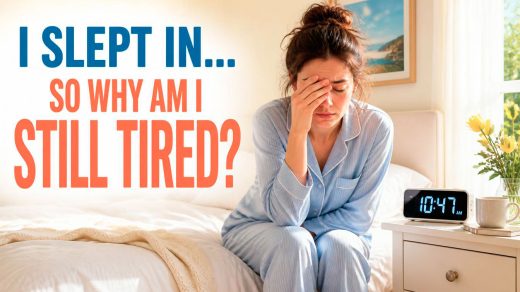

Getting enough sleep still matters. But your nightly average can hide something important: how much your sleep schedule shifts from one day to the next.
Imagine two people checking their sleep totals at the end of the week.
One slept roughly from 11:30 p.m. to 6:30 a.m. most nights.
The other slept five and a half hours on Monday, eight on Tuesday, six on Wednesday, then stayed up until 2 a.m. Friday and slept until 10 on Saturday.
Average everything together, and both might land near seven hours a night.
But they clearly did not have the same sleep week.
That difference is attracting increasing attention in sleep research. Scientists have long known that sleep duration matters. Now large studies suggest that when you sleep and how much your schedule changes from day to day may contain health information that an average nightly total misses.
That does not mean regularity has replaced duration as the most important sleep metric. Nor does it prove that tightening your bedtime by 30 minutes will prevent heart disease or add years to your life.
The more useful lesson is simpler: healthy sleep is a pattern, not just a number.
What Does “Regular Sleep” Actually Mean?
Sleep regularity sounds simple until you try to measure it.
Researchers can look at how much bedtime changes from night to night, how much wake time varies, whether sleep duration fluctuates, or how different someone’s workday and weekend schedules are. Some studies combine several dimensions into measures such as the Sleep Regularity Index, which estimates how consistently a person tends to be asleep or awake at the same points on consecutive days.
These measures overlap, but they are not interchangeable.
Someone might go to bed at midnight every night but wake at 6 a.m. during the week and 9 a.m. on weekends. Bedtime is stable; wake time and duration are not.
Another person might reliably sleep eight hours but shift the entire sleep period—10 p.m. to 6 a.m. on some days, 1 a.m. to 9 a.m. on others. Duration is consistent; timing is not.
It helps to separate four questions:
Duration: How much did you sleep?
Timing: When did you sleep?
Regularity: How much did that pattern change from day to day?
Circadian alignment: How well did your schedule line up with your internal biological timing?
A systematic review of 41 adult studies found that later sleep timing and greater variability were generally associated with less favorable health outcomes. But the researchers also found wide differences in how sleep regularity was defined and measured, and the quality of evidence varied by outcome.
In other words, research supports paying attention to regularity.
It does not give us a scientifically established minute-by-minute definition of a perfectly regular sleeper.
Why Would Your Body Care About Consistency?
Sleep operates within the circadian system—the biological machinery that helps coordinate roughly 24-hour rhythms throughout the body.
Light and darkness are powerful signals to that system. Sleep, meals, activity, and other behaviors also occur against this internal timing.
That is one reason a regular schedule should not be confused with an early schedule.
People differ naturally in when they tend to feel sleepy and alert. Someone who consistently sleeps from midnight to 8 a.m. may have a more stable pattern than someone who alternates between 9:30 p.m.–5:30 a.m. and 1 a.m.–9 a.m.
The concern with irregularity is not that midnight is inherently bad. It is that repeatedly shifting sleep and wake times may repeatedly change the relationship among sleep, light exposure, eating, activity, and internal circadian rhythms.
Laboratory experiments support the biological plausibility of that idea. When researchers deliberately push people’s behavioral schedules out of sync with their internal clocks, changes in glucose regulation and other physiological processes can occur.
But laboratory circadian disruption can be much more extreme and controlled than staying out late on Saturday.
Those experiments tell us that circadian misalignment can affect physiology. They do not prove that ordinary day-to-day schedule variation produces the same long-term consequences.
For that, researchers have had to watch how people actually sleep—and then follow their health over time.
Regularity Seems to Tell Us Something Duration Doesn’t
This is where the evidence becomes particularly interesting.
Across several large observational studies, irregular sleep remains associated with health outcomes even after researchers account for average sleep duration.
That does not prove regularity causes those outcomes. But it does suggest that knowing someone’s average nightly hours does not tell the whole story.
The cardiovascular signal is hard to ignore
In one major U.S. study from the Multi-Ethnic Study of Atherosclerosis, researchers used wrist activity monitors to estimate sleep for seven days in 1,992 adults ages 45 to 84 who had no cardiovascular disease when the study began.
They measured night-to-night variation in sleep duration and sleep onset, then followed participants for cardiovascular events.
Over roughly five years, people with the most irregular sleep patterns experienced higher rates of cardiovascular events than those with the most regular patterns. The association persisted after researchers adjusted for average sleep duration and numerous demographic, behavioral, and cardiovascular factors.
That is stronger evidence than simply asking people how they slept and whether they currently have heart disease: the sleep measurements came first, and the health events came later.
But it was still observational.
Researchers did not randomly assign people to years of regular or irregular sleep. Some unmeasured difference between the groups could still contribute to the result.
More recent prospective studies using wearable-derived sleep data have reported similar associations between irregular sleep and later cardiovascular outcomes.
The pattern is becoming more convincing.
Whether irregularity itself is causing the additional risk is harder to establish.
Metabolic health is more complicated
Research on metabolism points in a similar direction, but with less consistency.
Another analysis from the Multi-Ethnic Study of Atherosclerosis linked greater variability in sleep duration and timing with metabolic abnormalities, including features of metabolic syndrome.
A systematic review of 63 studies also found associations between sleep variability and several cardiometabolic outcomes. But the results changed depending on what researchers meant by “irregular.” Some measures showed clearer relationships than others, and studies of social jet lag and body weight, for example, were far from uniform.
That makes a statement such as “irregular sleep disrupts your metabolism” too broad.
Blood pressure, glucose regulation, body weight, metabolic syndrome, and diabetes are different outcomes. Bedtime variability, duration variability, and workday-weekend shifts are different exposures.
There may be important connections among them.
There is not yet one simple metabolic story.
Mental health can affect sleep—and vice versa
The relationship becomes even harder to untangle with mental health.
Observational research has linked greater sleep regularity with lower risks of depression and anxiety, even after accounting for sleep duration. Other studies have connected irregular sleep timing with depressive symptoms and psychological well-being.
But the arrows can easily run both ways.
Mood can change when people sleep, how long they remain in bed, how active they are, and how predictable their routines become. Anxiety can make sleep onset less predictable. Stress, medications, illness, work schedules, and social routines can influence both mental health and sleep.
So even when irregular sleep predicts later mental-health outcomes, researchers still have to ask whether irregularity contributed to the problem, reflected an emerging problem, or both.
What About the Studies Saying Regularity Matters More Than Duration?
Some of the most striking headlines about sleep regularity come from mortality research.
A 2024 UK Biobank study analyzed more than 10 million hours of wearable data from 60,977 adults. Researchers calculated a Sleep Regularity Index and followed participants for an average of about six years.
People with more regular sleep had lower all-cause and cause-specific mortality risk after extensive statistical adjustment.
The study also found that sleep regularity predicted mortality more strongly than sleep duration in its statistical models.
That sounds like a verdict: regularity beats duration.
It isn’t.
A variable can be a stronger predictor in one dataset without being a more important cause of disease—or a more powerful target for intervention.
The study did not take irregular sleepers, make their schedules more regular, and show that they lived longer. Nor did it establish that someone who sleeps too little would be better off preserving a perfectly consistent short-sleep schedule.
What it showed is still important: regularity contained information about future health that sleep duration alone did not capture.
That is a reason to broaden how we think about sleep.
It is not a reason to replace one sleep obsession with another.
The Causation Problem Runs Both Ways
Suppose irregular sleepers repeatedly show higher rates of cardiovascular or metabolic disease.
Why?
One possibility is that irregularity itself contributes.
Repeated shifts in sleep timing may affect circadian alignment. They may also change light exposure, meal timing, activity, sleep continuity, and other behaviors that influence health.
The biology makes this plausible.
But now reverse the arrow.
Pain can make sleep unpredictable. Insomnia and sleep apnea can alter sleep duration and timing. Depression, anxiety, fatigue, chronic illness, and medications can all change when and how people sleep.
Poor health may therefore make sleep more irregular.
Then there are factors that can influence both.
A shift worker may sleep irregularly because the job requires it. A parent may be awakened by a child. A caregiver may have unpredictable nights. Someone working two jobs may have little control over bedtime. Housing conditions, neighborhood noise, stress, chronotype, income, and social schedules can all shape sleep while also being connected to health.
Researchers try to account for these differences statistically.
They cannot eliminate every possibility.
That is why intervention studies are so important. If irregular sleep itself contributes to disease, deliberately making people’s sleep more regular should eventually improve relevant health outcomes.
So far, that evidence is much thinner.
Small and emerging interventions suggest that sleep timing can be changed. But showing that people can move their bedtimes closer together is not the same as showing fewer heart attacks, less diabetes, or longer life.
The observational evidence that regularity matters as a marker of health is increasingly persuasive.
The evidence that deliberately increasing regularity prevents long-term disease is still developing.
The Weekend Problem
Then Friday night arrives.
You stay up late, sleep in Saturday, and suddenly your beautifully regular schedule is gone.
Is that bad?
Not necessarily.
Researchers often use the term social jet lag for differences between workday and free-day sleep timing. Large shifts can reflect a mismatch between someone’s biological preferences and the schedule imposed by work, school, or other obligations.
But sleeping later on weekends can mean several different things.
It may represent unstable sleep timing.
It may reveal a naturally later body clock forced earlier during the workweek.
Or it may simply be an attempt to recover from not getting enough sleep Monday through Friday.
Those situations should not be treated as identical.
Reviews have generally linked greater social jet lag with less favorable health outcomes, although evidence quality varies. At the same time, research on weekend catch-up sleep has sometimes found favorable associations, and experimental studies suggest that recovery sleep can reverse at least some short-term effects of sleep restriction under specific conditions.
That does not mean you can reliably erase five nights of inadequate sleep by sleeping until noon on Sunday.
But it does reveal an important conflict between two pieces of sleep advice.
Suppose you have slept only six hours a night all week even though you need more. Should you force yourself out of bed early Saturday solely to preserve a perfectly consistent wake time?
Current evidence does not justify treating chronic insufficient sleep as a victory simply because it happens on schedule.
Regularity should support adequate sleep, not compete with it.
If you repeatedly need much more sleep on days off, the weekend may not be the real problem.
Your weekday schedule may be.
So, Does Regularity Matter as Much as Duration?
There is no scientifically defensible way to assign the two equal weights.
Sleep duration has a long-established evidence base. The American Academy of Sleep Medicine and Sleep Research Society recommend that adults generally sleep at least seven hours per night on a regular basis to support optimal health, while individual sleep needs vary.
Regularity has a newer but rapidly growing evidence base.
Prospective studies using objective measurements suggest that substantial sleep variability predicts cardiovascular events and mortality even after average duration is considered. Other studies link irregular sleep with metabolic and psychological outcomes.
But the causal evidence is not equally developed.
Researchers know a great deal about what sleep restriction can do under controlled conditions. We know much less about whether taking someone who already sleeps enough but irregularly and stabilizing that person’s schedule will prevent disease years later.
So claims that regularity is simply “more important” than duration go beyond what the evidence can currently establish.
A better model is to stop making sleep dimensions compete.
Duration asks whether you got enough sleep.
Timing asks when you slept.
Regularity asks how stable that pattern was.
Quality and continuity ask whether the sleep itself was reasonably consolidated and restorative.
Each can tell us something the others miss.
And in real life, they often interact.
How Regular Is Regular Enough?
This is where the research becomes much less precise than your wearable may suggest.
There is no universally validated cutoff at which normal schedule variation suddenly becomes harmful.
Population studies can identify gradients: people with greater variability may have different health outcomes than people with more stable schedules. But that does not reveal a biological cliff where 59 minutes of variation is fine and 61 minutes becomes dangerous.
The National Heart, Lung, and Blood Institute advises going to bed and waking at roughly the same time each day and suggests limiting the difference between weekday and weekend schedules to about an hour when practical.
That is useful guidance.
It is not evidence that every hour of deviation carries a measurable penalty.
A late night out, an early flight, a sick child, or sleeping longer after an exhausting week does not mean your sleep routine has failed.
The research is much more relevant to patterns of repeated variability than to occasional exceptions.
And regularity is not always under a person’s control. Shift workers, caregivers, parents of young children, students, people managing illness, and those working unpredictable or multiple jobs may have limited freedom to choose when they sleep.
Sleep regularity should not become another standard people are expected to achieve perfectly.
A More Useful Way to Judge Your Sleep Week
Instead of asking whether you hit one ideal number every night, look at the pattern.
Start with enough sleep. Regularity is not a substitute for adequate duration. For most adults, at least seven hours per night remains the established general recommendation, though individual needs vary.
Look beyond the average. A seven-hour weekly average can hide repeated short nights, long recovery sleeps, and major shifts in timing.
Notice patterns rather than exceptions. One late night is different from repeatedly moving sleep several hours backward and forward.
Don’t confuse “late” with “irregular.” A later but stable schedule is not the same thing as a constantly shifting one.
Ask why your schedule changes. Regularly sleeping much longer on free days may be a clue that your weekday schedule is not providing enough sleep opportunity.
Aim for reasonable consistency, not clockwork precision. Current evidence supports stability as part of healthy sleep, but it does not justify obsessing over small nightly deviations.
Wearables can help reveal longer-term patterns in bedtime, wake time, and sleep duration. But consumer devices estimate sleep, and their proprietary scores can create an impression of precision that the underlying science does not always support.
Use the data to notice patterns—not to turn bedtime into a nightly performance test.
Healthy Sleep Is More Than a Total
Return to those two people averaging seven hours.
The arithmetic says their sleep is the same.
Their weeks say otherwise.
Research increasingly suggests that substantial variation in when and how long we sleep contains health information that an average nightly total can hide. The associations with cardiovascular health and mortality are especially notable, while metabolic and mental-health research adds further reasons to pay attention.
What science has not established is that regularity matters exactly as much as duration—or that simply tightening your sleep schedule will reverse the long-term risks observed in irregular sleepers.
The emerging lesson is more useful than that.
Sleep health is multidimensional.
How long you sleep matters. So does when you sleep, how much that timing shifts, and whether your sleep is reasonably continuous and restorative.
Regularity deserves a place in that picture. It does not need to become the new number everyone chases.
Instead of asking only, “How many hours did I sleep?” ask a better question: “Am I getting enough sleep on a reasonably stable rhythm?”