
Two weeks without workouts can affect your endurance, strength, and muscles in surprisingly different ways. Here’s what actually changes—and why a break doesn’t mean starting over.
You’ve spent months building your fitness.
The run that once left you exhausted now feels manageable. The weights that used to challenge you have become part of your normal routine.
Then life gets in the way.
Maybe you’re traveling, recovering from an illness, or simply too busy to exercise. Before you know it, two weeks have passed without a workout.
And you start wondering:
Did those two weeks undo months of progress?
Probably not. But some changes may already be happening.
Research shows that cardiovascular fitness can begin declining within the first few weeks of stopping regular training. Muscular strength often changes more slowly, while actual muscle loss follows a less predictable timeline.
The reason is surprisingly simple: fitness isn’t one thing that disappears all at once.
Your heart, muscles, and nervous system adapt to exercise in different ways. When training stops, those adaptations don’t all reverse at the same speed.
Understanding that difference makes a training break look considerably less catastrophic.
Why Cardio Fitness Can Decline Within Weeks
Imagine going for your first run after several weeks away.
You’re following a familiar route, but something feels different.
Your usual pace requires more effort. You get tired sooner. The same distance doesn’t feel quite as easy as you remember.
There’s a physiological reason this can happen.
Endurance training improves your body’s ability to deliver and use oxygen during sustained activity.
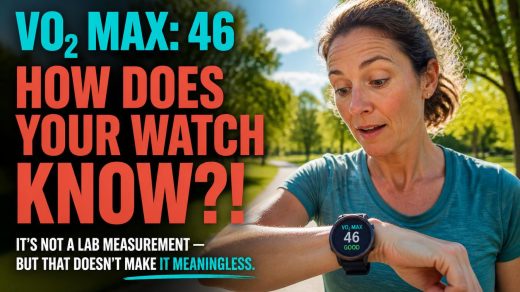
Researchers often measure that capacity using VO₂max—the maximum amount of oxygen your body can take in, transport, and use during demanding exercise.
Regular endurance training can increase VO₂max through adaptations involving the heart, blood circulation, and working muscles.
But some of those changes begin reversing relatively quickly when training stops.
One of the earliest involves blood plasma volume.
Plasma is the liquid component of blood. Endurance training can increase the amount circulating through your body, helping the heart deliver blood to working muscles during exercise.
When training stops, plasma volume can decrease.
That can reduce the amount of blood the heart pumps with each beat during demanding activity, limiting how much oxygen reaches the muscles.
The result? Your aerobic capacity may decline even before all the adaptations inside your muscles have substantially changed.
A classic 1984 experiment demonstrated how quickly this can happen.
Researchers followed seven endurance-trained adults after they completely stopped their usual training.
Their VO₂max declined by approximately 7% during the first 21 days.
By 56 days, it had fallen about 16% below their original trained level.
That’s a noticeable physiological change in less than two months.
But the experiment revealed something else.
Even after 84 days without training, the participants still had higher average aerobic capacity than an untrained comparison group.
Their endurance had declined, but not everything they had developed was gone.
This was a small study involving highly trained people, so its percentages shouldn’t be treated as predictions for everyone.
Still, larger research supports the general pattern.
A 2022 systematic review and meta-analysis of 21 studies found that athletes experienced significant reductions in VO₂max after both shorter and longer training interruptions, with larger overall declines following longer breaks.
The important takeaway isn’t that everyone loses a particular percentage of endurance after two weeks.
It’s that aerobic fitness can begin changing within weeks, especially after complete training cessation.
And a decline in VO₂max doesn’t necessarily translate into an identical percentage decline in running speed or every other measure of endurance.
Cardiovascular fitness is only one part of the picture.
Your muscles can respond quite differently.
Does Strength Disappear as Quickly as Endurance?
Suppose you return to the gym after two weeks away.
The first few repetitions feel unfamiliar. Your movements seem less smooth, and a weight you previously handled comfortably requires more concentration.
Does that mean you’ve lost muscle?
Not necessarily.
Muscle strength and muscle size aren’t the same thing.
Strength describes your ability to produce force.
It depends partly on how much muscle tissue you have, but also on how effectively your nervous system activates and coordinates that tissue.
Muscle size, meanwhile, refers to the amount of muscle tissue itself.
Those two characteristics are related, but they don’t always change together.
A familiar lift may feel harder after a break because you’re temporarily less accustomed to performing it—not necessarily because you’ve lost a substantial amount of muscle.
And a short break can sometimes have the opposite effect.
If you’ve been training hard, time away may reduce accumulated fatigue, allowing you to perform just as well—or occasionally better—when you return.
But what happens when resistance training stops for longer?
A 2013 meta-analysis examined 103 studies investigating the effects of training cessation on muscular performance.
The researchers found that stopping resistance training generally reduced measures of muscular strength, force, and power.
However, the size of those reductions varied.
Longer interruptions were associated with greater losses, while age and previous training status also influenced the results.
That supports a broad conclusion: strength can decline without continued training.
What it doesn’t establish is a universal deadline.
There’s no scientifically reliable rule that everyone starts losing strength after exactly seven, 10, or 14 days.
During relatively short breaks, strength may remain largely preserved.
Over longer periods, declines become more likely, but the rate varies considerably.
And actual muscle size is another question.
When Do You Start Losing Muscle?
This is where popular fitness advice often becomes much more confident than the research.
You may have heard that muscles begin shrinking after two weeks—or that everything you’ve built starts disappearing after a certain number of missed workouts.
The evidence doesn’t support one precise countdown.
A 2022 systematic review examined how stopping resistance training affects previously developed strength and muscle growth.
The researchers found that some strength improvements could remain above untrained comparison levels after substantial interruptions.
However, the available studies were too limited and inconsistent to establish confidently how long strength and muscle-size gains persist across different detraining periods.
In particular, there wasn’t enough suitable evidence to calculate a reliable overall estimate for muscle-size changes.
That doesn’t mean muscles never become smaller when training stops.
Without a continued training stimulus, muscle-related adaptations can diminish, particularly during longer periods of inactivity.
But a change in muscular performance—or even a change in muscle measurements—doesn’t necessarily represent an equivalent loss of muscle tissue.
Muscles also contain stored carbohydrate, called glycogen, and associated water. Changes in those stores can affect measurements of muscle size without corresponding directly to changes in the amount of actual muscle tissue.
So three things can happen on different timelines:
- Your endurance capacity may decline.
- Your ability to produce force may change.
- Your actual muscle tissue may remain relatively stable for a time or decline with longer inactivity.
Losing some cardiovascular fitness doesn’t mean you’ve lost the same proportion of strength or muscle.
That distinction is why a person can feel noticeably less fit during a run while performing almost normally during a strength workout.
Why the Same Two-Week Break Affects People Differently
Imagine two people taking identical breaks.
One is a competitive runner who has spent years developing exceptional endurance.
The other exercises recreationally several times a week.
Both stop their usual training for 14 days.
Should they expect the same changes?
No.
The effects of a break depend on what someone has trained for, how extensively they’ve trained, and what happens while they’re away.
Highly trained endurance athletes may experience relatively rapid changes in cardiovascular adaptations when their usual training stimulus disappears.
Someone who exercises recreationally may follow a different pattern.
That doesn’t mean one person’s fitness is necessarily more fragile. They may simply have different starting capacities and adaptations.
And there’s another distinction that often gets overlooked.
Taking a break from workouts isn’t the same as becoming completely inactive.
Someone might stop running or visiting the gym but continue walking, climbing stairs, and moving normally throughout the day.
Another person might spend much of the same period in bed because of an illness or injury.
Those situations place very different demands on the body.
Research involving prolonged bed rest or immobilization shouldn’t automatically be applied to someone who has simply stopped structured workouts for a couple of weeks.
The reason for the break matters, too.
Illness, inadequate recovery, and injury can affect how someone feels and performs independently of detraining. If a break is needed for recovery, that takes priority over concerns about preserving every training adaptation.
And fitness loss doesn’t necessarily happen at a constant rate.
Some changes appear relatively early. Others develop more gradually. Certain adaptations can persist even after a substantial interruption.
Remember the endurance-trained participants in the 1984 experiment?
After almost three months without training, their aerobic capacity had declined considerably.
Yet they still retained measurable advantages over people who hadn’t undergone comparable endurance training.
Their progress had been reduced—not erased.
So How Much Fitness Can You Lose in Two Weeks?
For many people, two weeks without exercise will not undo months of training.
But the effect depends on what you’re measuring.
Cardio fitness: Some physiological changes can occur relatively quickly, with measurable reductions in aerobic capacity appearing within the first few weeks of complete training cessation.
Strength: A short break may cause little measurable decline, especially when someone was previously well trained. Longer interruptions generally increase the likelihood of strength losses.
Muscle size: Actual tissue changes are harder to predict. Research doesn’t establish a precise point at which everyone begins losing muscle.
Those differences explain why your first workout back might feel harder without meaning you’ve returned to where you started.
A training break changes the stimulus your body receives. Some adaptations begin reversing, while others remain.
And the experience of returning to exercise isn’t a perfect measurement of what you’ve lost. Temporary fatigue, unfamiliar movement, recent illness, and other circumstances can influence performance.
So if two weeks have passed since your last workout, there’s no reason to assume months of progress have vanished.
The most important distinction is between losing some fitness and losing all the fitness you’ve developed.
Those are very different outcomes.
Exercise creates adaptations that respond to changing demands. Some fade relatively quickly when training stops. Others persist much longer.
A break can change your fitness. It doesn’t automatically send you back to the beginning.