
Exercise, diet, sleep, and other habits can clearly change how healthy and capable you remain as you get older. Proving that they literally slow one underlying biological aging process is a much harder claim.
A workout “slows aging.” A diet makes your cells younger. A fasting routine turns back your biological clock.
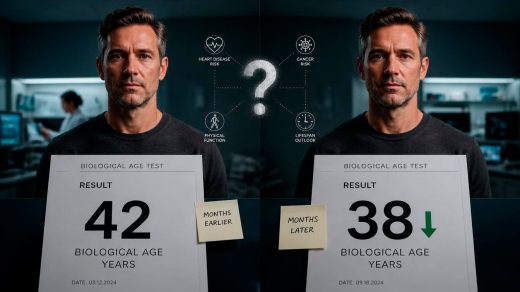
Then a test says your biological age dropped three years.
It sounds wonderfully concrete: you did something healthy, and your body became younger.
But what, exactly, became younger?
Your arteries? Your muscles? Your risk of disease? Your ability to climb stairs at 80? A pattern of chemical marks on your DNA? Your chances of living longer?
Those outcomes can be related, but they are not interchangeable. And that distinction is at the center of one of longevity science’s most interesting questions.
Lifestyle can unquestionably change how we age. Exercise can improve fitness and strength. Diet can change cardiovascular and metabolic risk. Sleep affects health and functioning. Quitting smoking can dramatically alter future disease and mortality risk.
What science cannot yet say with the same confidence is that these changes represent a slowing—or reversal—of one master biological aging process.
To understand why, we first have to confront an inconvenient problem:
There is no single speedometer for aging.
Your Body Does Not Have One Biological Clock
Chronological age is wonderfully simple. It is the time since you were born.
Biological aging is not.
As years pass, changes accumulate across muscles, bones, blood vessels, metabolism, the immune system, brain, sensory systems, cells, and molecular processes. Those systems do not necessarily change at the same rate—even within the same person.
A 2026 Nature Medicine review illustrates how complicated the measurement problem has become. Researchers now have biological “clocks” built from DNA methylation, proteins, clinical measures, and patterns within specific organs and tissues. Some are designed to approximate chronological age. Others try to predict disease, mortality, or the pace of physiological change.
They can disagree because they are not all measuring the same thing.
So when someone says, “My body is aging faster,” the scientifically important question is: faster in what sense?
Losing strength more quickly? Accumulating diseases? Showing poorer cardiovascular health? Producing a higher score on a particular molecular algorithm?
The World Health Organization takes a deliberately more practical view of healthy aging. Its framework emphasizes functional ability—whether people can be and do what they value—which depends not only on physical and mental capacities but also on the environments in which people live.
That is harder to package into a dramatic number.
But it is much closer to what most people ultimately want from a longer life.
The Bigger the Anti-Aging Claim, the More Evidence It Needs
Imagine hearing that a new habit “slows aging.”
What would actually count as proof?
At the easiest level, researchers might show biological plausibility: the habit affects a cellular pathway involved in processes associated with aging.
Interesting. But mechanisms do not tell us whether people become healthier.
Next, an intervention might change a biomarker—blood pressure, an inflammatory marker, or an epigenetic clock.
Now something measurable happened. We still need to know what the change predicts.
Observational studies can go further by showing that people with certain lifestyles tend to experience less disease or live longer. But people who exercise, eat differently, sleep well, or avoid smoking may differ from other people in many additional ways.
Randomized intervention trials can provide stronger evidence by deliberately changing a behavior and measuring what follows.
And then there is the strongest version of the claim: show that an intervention changes a validated measure of biological aging and that changing that measure reliably translates into better long-term health.
That final step is where much of longevity science is still working.
A headline can move from “this changed an aging-related biomarker” to “this reversed aging” in a few words.
Scientifically, that is an enormous leap.
Exercise Shows Why the Label May Matter Less Than the Outcome
If you wanted to make the strongest case that lifestyle changes the experience of aging, exercise would be an obvious place to start.
Aerobic activity improves cardiorespiratory fitness. Resistance training improves muscular strength. Physical activity supports mobility and physical function, and balance training becomes particularly relevant later in life. U.S. recommendations for older adults therefore include all three: aerobic activity, muscle strengthening, and balance work.
These benefits do not require a molecular clock to make them meaningful.
Imagine two people reaching older age with very different physical reserves. One can comfortably climb stairs, carry groceries, get up from the floor, and walk substantial distances. The other finds those same demands increasingly difficult.
Even if no test can tell us exactly how many “biological years” separate them, the difference in capacity matters.
That exposes something important about anti-aging language.
If exercise preserves strength and function, improves fitness, and reduces important health risks, calling it “anti-aging” does not necessarily tell us anything more useful.
It may actually tell us less.
Diet Has the Same Problem
Diet is routinely promoted as a way to slow aging, but several different claims are hiding inside that phrase.
Healthy dietary patterns can improve established cardiovascular and metabolic risk factors. Long-term observational studies also link higher-quality diets with lower risks of many chronic health outcomes.
That is already important.
But saying a diet slows biological aging requires additional evidence.
Calorie restriction offers an unusually revealing example because it has been studied extensively in aging research. In laboratory organisms, reducing calorie intake without malnutrition can affect lifespan and aging-related biology. Humans are considerably harder to study.
The CALERIE trial provided a rare randomized human test. Adults without obesity were assigned to two years of calorie restriction, and researchers later examined several DNA-methylation measures of biological aging.
The result was not a simple “aging reversed” story.
Calorie restriction produced a modest slowing in DunedinPACE, a measure designed to estimate pace of aging, while other epigenetic measures did not show the same pattern.
That disagreement is exactly what matters.
If one aging clock moves while another does not, we cannot simply translate the result into “people became younger.”
Nor did the trial demonstrate that calorie restriction extends human lifespan.
What it did provide was something scientifically valuable: evidence that a sustained lifestyle intervention can affect at least some molecular measures designed to capture aspects of aging.
That is intriguing.
It is not the same as proving that aging itself was slowed.
Sleep Can Matter Without Being “Anti-Aging”
Sleep produces a similar temptation.
Poor or irregular sleep is associated with health outcomes that become increasingly important across adulthood. Sleep can influence alertness, mood, metabolic regulation, cardiovascular health, and everyday functioning.
Those connections make sleep highly relevant to healthy aging.
They do not automatically make sleep an age-reversal intervention.
If improving someone’s sleep helps them function better during the day, supports healthier blood pressure, or improves quality of life, the intervention has succeeded at something meaningful—even if an epigenetic clock never moves.
This distinction appears again and again:
A behavior does not need to “slow aging” to improve the way you age.
Smoking Reveals How Strange the Longevity Language Can Become
Smoking offers a useful reality check because the evidence is much less ambiguous.
Cigarette smoking increases the risk of cardiovascular disease, cancer, chronic lung disease, and premature death. Quitting reduces those risks.
The CDC reports that smoking cessation can add as much as 10 years to life expectancy compared with continuing to smoke, with some cardiovascular risks beginning to fall relatively soon after quitting.
Should we call quitting smoking an anti-aging intervention?
We could.
But why would we need to?
We already have a much more informative statement: quitting smoking reduces the risk of serious disease and premature death.
This points to an odd feature of longevity culture. Some of the behaviors with the strongest evidence for changing later-life health require the least exotic language.
They do not need to “reverse biological age” to matter.
Boring Measurements Can Be More Useful Than Exciting Ones
The same principle applies to familiar medical risk factors.
Blood pressure is not a futuristic aging biomarker. Neither are cholesterol, blood glucose, physical fitness, or smoking status.
That can make them seem almost dull next to a test promising to reveal the “true age” of your body.
But familiar measures have a major advantage: researchers know far more about what many of them mean.
Blood pressure is a good example. Randomized trials have shown that treating elevated blood pressure can reduce major cardiovascular outcomes in appropriate patients. Those results give clinicians something an experimental aging clock usually cannot yet provide: evidence that deliberately changing the measurement can change meaningful health outcomes.
That does not mean every person should pursue the same blood-pressure target; treatment decisions depend on individual circumstances.
The broader lesson is more important.
A less glamorous measurement can be more useful if we know what changing it actually accomplishes.
Biological-Age Tests Make Aging Look More Precise Than It Is
This is where aging clocks become both fascinating and easy to misunderstand.
Suppose you are 50.
A test reports a biological age of 44.
It is natural to read that result literally: somewhere underneath your chronological age, your body is “really” six years younger.
But that is not what current biological-age science can establish so simply.
Different clocks can be constructed from different biological information and optimized for different purposes. A clock may be useful for predicting mortality or disease risk without being a literal measurement of the age of your entire body.
And prediction creates another problem.
Imagine a biomarker that accurately predicts future disease.
Now imagine an intervention lowers that biomarker.
It is tempting to conclude that the intervention must have lowered disease risk by slowing aging.
But that does not automatically follow.
A marker can predict an outcome without being part of the causal process producing that outcome. And changing the marker does not necessarily change the outcome it predicts.
This is the difference between a useful biomarker and a validated surrogate endpoint—a measurement reliable enough to stand in for the health outcome researchers ultimately care about.
That distinction is one of the biggest unresolved issues in human longevity research.
So What Does It Mean When a Study “Reverses Biological Age”?
This question became even more interesting in 2026.
Researchers assembled DNA-methylation data from 51 longitudinal human intervention studies and recalculated a standardized set of 16 prominent epigenetic clocks, along with dozens of additional DNA-methylation biomarkers. The goal was partly to determine which aging measures respond consistently enough to interventions to become useful in longevity trials.
The results showed why this field needs systematic testing.
Different biomarkers did not respond identically. Intervention type mattered. The population being studied mattered. Some clocks appeared more responsive than others.
Importantly, the researchers did not treat responsiveness alone as proof that a clock is a validated substitute for lifespan or healthspan outcomes. The work is part of the process of determining whether these biomarkers can eventually serve that role.
So when a study reports that an intervention “reversed biological age by three years,” the safest translation is often much less dramatic:
A particular biological-age estimate decreased.
That can be scientifically interesting.
It does not mean the person’s entire body literally became three years younger.
Why This Is Such a Difficult Problem to Solve
Researchers have good reason to want reliable aging biomarkers.
Imagine testing whether an intervention extends healthy human life.
The most obvious experiment would require large groups of people, careful randomization, and potentially decades of follow-up. That is expensive, slow, and extraordinarily difficult.
A validated aging biomarker could compress that timeline.
Instead of waiting decades for differences in disease, disability, or mortality to emerge, researchers might be able to measure whether an intervention is changing the underlying aging process much sooner.
That would be transformative.
But there is a catch: the biomarker has to be validated before researchers can confidently use it as a substitute for the outcome.
Otherwise, longevity research risks becoming circular:
An intervention works because it improved an aging biomarker.
And we know the biomarker matters because interventions can improve it.
The missing link is showing that intervention-driven changes in the biomarker reliably predict intervention-driven improvements in outcomes people actually care about.
That is why aging clocks are promising without yet being definitive.
Lifestyle Still Matters—A Lot
None of this means your habits are powerless against aging.
Quite the opposite.
The problem is not that lifestyle does too little.
It is that the phrase “slows aging” tries to squeeze too many different benefits into one claim.
Exercise can change physical capacity.
Diet can influence cardiovascular and metabolic health.
Sleep can affect functioning and health.
Quitting smoking can dramatically change disease and mortality risk.
And some interventions can change molecular measurements associated with biological aging.
Those are all real possibilities.
They simply belong at different levels of evidence.
Lifestyle also does not operate in isolation. Genetics, healthcare, occupation, income, neighborhood conditions, pollution, disability, chronic stress, social circumstances, and chance all shape health across a lifetime. WHO’s healthy-aging framework explicitly recognizes that functional ability emerges from both a person’s capacities and the environment around them.
So two extremes are equally misleading:
“Your genes determine how you age.”
and
“You control how fast you age.”
Lifestyle can change important probabilities.
It cannot give anyone complete control over aging.
What Deserves Your Attention Right Now?
If your goal is to age well, the strongest evidence does not require you to optimize a biological-age score.
It points toward much more familiar priorities.
Regular physical activity—including aerobic exercise and muscle strengthening—supports health and physical function across adulthood. For older adults, balance activity becomes another important part of the picture.
For people who smoke, quitting has exceptionally strong evidence for improving future health and reducing premature mortality.
A nutritious dietary pattern, adequate sleep, appropriate medical care, and management of established risk factors such as high blood pressure also have far more directly interpretable health implications than trying to chase the lowest possible biological-age score.
That does not make biological-age research irrelevant.
It puts it in the right place.
Aging biomarkers are potentially powerful research tools. They may eventually help scientists test longevity interventions much faster than waiting decades for disease and mortality outcomes. The rapidly developing research published in 2026 is an important step toward finding out which measures are actually reliable enough for that job.
For now, they are better viewed as additional evidence, not the final scoreboard for whether your lifestyle is working.
How to Read the Next “Anti-Aging” Headline
When a study claims that something slows or reverses aging, one question can prevent a great deal of confusion:
What actually changed?
Was it a molecular pathway? A blood marker? An epigenetic clock? Blood pressure? Strength? Disease incidence? Disability? Mortality?
Then ask whether the study was conducted in humans, whether there was an appropriate comparison group, how large the effect was, and whether researchers measured an outcome people actually care about.
A mouse living longer is important aging research.
A human epigenetic clock moving is important aging research.
A person becoming stronger is important aging research.
A reduction in heart attacks is important aging research.
But those findings do not all prove the same thing.
And perhaps the most important question is this:
Do we know that changing the measurement changes future health?
If the answer is no, the finding may still be exciting.
It just should not be promoted as proof that aging has been reversed.
You Don’t Need to Become “Younger” to Age Better
So can lifestyle really change how fast you age?
The best answer depends on what you mean by age.
If you mean whether lifestyle can influence strength, fitness, physical function, cardiovascular and metabolic health, disease risk, and the chances of remaining capable later in life, the answer is clearly yes.
If you mean whether lifestyle can change certain biomarkers designed to capture aspects of biological aging, there is also evidence that some interventions can.
But if you mean whether scientists can already prove that a particular lifestyle literally slows or reverses one universal underlying rate of human aging, the evidence is not there yet.
And that may be less disappointing than it sounds.
A person who reaches later life stronger, fitter, healthier, and better able to do what matters has achieved something important regardless of whether an algorithm calls their body 58, 61, or 64.
The goal does not have to be making 60 “really 50.”
It can be making 60 healthier and more capable than it otherwise would have been.
You do not need proof that a habit slows aging for it to meaningfully improve how you age.