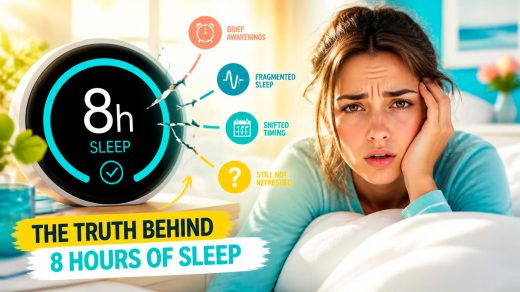

Extra sleep after several short nights can genuinely help. But sleep loss is not a simple debt that the body repays hour for hour.
Monday runs late. Tuesday starts early. By Wednesday, bedtime has slipped past midnight, but the alarm has not moved.
By Friday, you are running on less sleep than you wanted.
Then Saturday arrives. No alarm. You sleep two hours later than usual and wake feeling almost human again.
It is tempting to imagine that you have paid back the week’s missing sleep.
But what, exactly, did you repay?
Sleepiness? Attention? Reaction time? Metabolic changes? The biological pressure to sleep? And if you slept several hours later than usual, did recovery come with a shift in your body clock?
That is where the tidy idea of “sleep debt” begins to break down.
Controlled experiments show that extra sleep after restriction can improve alertness, performance, and some physiological changes. They also show that one long night—or even a weekend—does not reliably return every measure to baseline.
So catch-up sleep is neither a perfect reset nor a waste of time.
It is recovery. And recovery does not happen on one clock.
Sleep Debt Is a Useful Metaphor—Until You Start Doing the Math
Suppose you normally sleep eight hours but get six hours for five nights.
It is natural to think:
Five nights × two missing hours = ten hours of sleep debt.
Sleep ten extra hours later, and the account should balance.
The body is not that good at bookkeeping.
One classic laboratory experiment makes the problem clear. Healthy adults were assigned four, six, or eight hours in bed per night for two weeks. In the four- and six-hour groups, cognitive performance progressively deteriorated as the short nights accumulated. Yet people’s subjective sleepiness did not worsen in parallel.
In other words, participants became increasingly impaired without feeling proportionally worse.
That matters because sleep loss does not create one unified deficit. Attention, sleepiness, mood, metabolic function, and other responses can change on different timelines.
It also means “I’ve gotten used to six hours” can be misleading. You may become accustomed to how restricted sleep feels without your performance fully adapting to it.
The American Academy of Sleep Medicine and Sleep Research Society recommend that adults regularly get at least seven hours of sleep, while recognizing that individual needs vary and that longer sleep can be appropriate when recovering from sleep debt.
What that recommendation does not provide is a formula for calculating exactly how many recovery hours you need.
One Long Night Helps. It May Not Finish the Job.
A long sleep after several short nights often feels unusually good for a reason: after insufficient sleep, the drive to sleep is stronger, and giving yourself more opportunity allows real recovery.
The interesting question is how complete that recovery is.
In a controlled experiment involving 159 healthy adults, researchers restricted sleep to four hours in bed for five consecutive nights. Participants then received different amounts of recovery opportunity, ranging from no sleep to ten hours in bed for one night.
More recovery sleep generally produced better results.
But even the longest recovery opportunity did not return every measure of alertness, sleepiness, fatigue, and performance completely to baseline.
That gives us a much better rule than the sleep-bank metaphor:
Feeling better is evidence of recovery. It is not proof that recovery is complete.
This distinction is especially important for attention.
After repeated short sleep, the ability to remain consistently alert can deteriorate. That matters for activities such as driving, repetitive work, or catching mistakes—situations where a brief lapse can matter more than your overall sense of being awake.
And recovery can have a long memory. In a more recent laboratory experiment, researchers put adults through two five-day periods of severe sleep restriction separated by a single recovery opportunity. The extra sleep had only a modest, short-lived effect on performance during the second restriction period; prior sleep-wake history continued to matter.
One heroic Saturday morning, in other words, should not be expected to make repeated short sleep irrelevant.
Your Metabolism May Recover on a Different Schedule
The picture becomes even more complicated when researchers move beyond sleepiness and attention.
Experimental sleep restriction can temporarily alter glucose regulation and insulin sensitivity. Some studies have found that substantial recovery sleep can reverse at least some of those changes.
But that does not mean a weekend reliably repairs the metabolic effects of a short-sleep workweek.
A particularly revealing 2019 randomized experiment compared adequate sleep with repeated five-hour sleep opportunities and a pattern of five short nights followed by weekend recovery sleep.
When participants were allowed to recover, they slept longer. Some behaviors improved.
But once sleep restriction resumed, the weekend-recovery pattern did not prevent the metabolic disruption associated with recurrent insufficient sleep. The recovery schedule also shifted circadian timing later.
The important lesson is not that recovery sleep “failed.”
It is that recovering from sleep loss and repeatedly recreating it are different problems.
A weekend may help you recover from the week that just happened without making a Monday-to-Friday pattern of insufficient sleep harmless.
And short-term metabolic experiments should not be stretched into claims that one bad week causes diabetes—or that one long weekend prevents it.
Sleeping Longer and Sleeping Later Are Not the Same Thing
Here is another wrinkle.
Catching up on sleep often means sleeping in.
Suppose your weekday schedule is midnight to 6 a.m. On Saturday, you sleep from 1 a.m. to 10 a.m.
You gained three hours of sleep.
You also shifted your sleep timing—and likely your morning light exposure—several hours later.
That can matter because sleep is governed not only by how long you have been awake but also by the circadian system that helps organize sleep and wakefulness across the roughly 24-hour day.
Large differences between workday and free-day sleep schedules are often described as social jet lag.
So weekend catch-up can create a real trade-off: extra sleep may help with insufficient sleep, while a large timing shift can make returning to an early schedule more difficult.
The practical conclusion is not “never sleep in.”
If you are genuinely sleep deprived, preserving an immaculate wake time by continuing to restrict sleep is not obviously the healthier choice.
The better target is more ordinary: enough sleep, with reasonable consistency whenever life allows it.
Does Weekend Catch-Up Sleep Protect Long-Term Health?
Laboratory experiments can manipulate sleep precisely. What they cannot easily do is tell us what decades of real life will look like.
Large observational studies can examine that question—but they introduce a different problem: researchers observe people’s existing sleep patterns rather than assigning them.
And the findings are not completely consistent.
A 2024 prospective study used wrist accelerometers to measure sleep in more than 70,000 adults and examined whether longer weekend sleep was associated with later cardiovascular disease or mortality. It found no clear protective association.
Then a 2026 Nature Communications study approached the question differently.
Researchers analyzed accelerometer data from 85,618 UK Biobank participants, looking for short-term patterns of sleep restriction followed—or not followed—by rebound sleep. Sleep restriction without rebound was associated with higher all-cause mortality risk in some analyses, while restriction followed by rebound was not associated with the same increase. The researchers also reported replication of the overall pattern in U.S. NHANES data.
That sounds encouraging for catch-up sleep.
But it still does not prove that sleeping longer after a short night caused the difference in mortality.
People who naturally recover sleep may differ from those who do not in health, schedules, work demands, sleep opportunity, illness, or other ways that statistical adjustment cannot completely remove.
The two studies also defined recovery differently. One focused on the familiar weekday-versus-weekend difference; the other examined day-to-day restriction-and-rebound patterns relative to an individual’s usual sleep.
That distinction may help explain why apparently similar questions can produce different answers.
For now, the long-term evidence supports a cautious conclusion: getting recovery sleep after a shortfall may be better than simply continuing to sleep too little, but it has not been established as a way to cancel the health effects of chronic insufficient sleep.
What About Naps?
Sleeping later on Saturday is not the only way to add sleep.
A nap can improve alertness and performance when you are sleepy, making it useful after occasional sleep loss. But a nap is not simply a miniature replacement for a full night.
Its effects depend on timing, duration, and how sleep deprived you are. Waking from a nap can also temporarily leave you groggy—a phenomenon known as sleep inertia.
The more important point is that the choice between “nap” and “sleep in” can distract from the underlying problem.
If weekdays routinely contain too little opportunity for sleep, rearranging recovery does not remove the reason you keep needing it.
What If You Have Been Sleeping Too Little for Months?
Here science becomes less satisfying.
Researchers can reasonably study five nights of restricted sleep followed by recovery under controlled conditions.
It is much harder to experimentally assign people to months or years of inadequate sleep and then determine exactly how long every affected system takes to recover.
That means most controlled recovery experiments tell us far more about short-term sleep restriction than about years of habitually short sleep.
We should not use those studies to claim that ordinary periods of insufficient sleep cause irreversible damage.
But the opposite conclusion is equally unsupported: two good nights cannot be assumed to erase months of inadequate sleep simply because they normalized a particular measure after a short laboratory experiment.
This is one reason the sleep-debt metaphor can become unhelpful.
There may be no meaningful answer to “How many hours do I owe?”
The better question is:
Am I returning to a pattern that regularly gives me enough sleep?
Why Both Extremes Get Catch-Up Sleep Wrong
Two claims often appear around this subject.
“You can completely repay lost sleep.”
And:
“You can never catch up on sleep.”
Neither captures the evidence very well.
Recovery sleep clearly does something. Controlled studies show that additional sleep after restriction can improve subjective sleepiness and cognitive performance, even when some measures remain below baseline.
But different consequences of sleep loss recover differently.
You may feel much better before your attention is completely restored. A metabolic measure may normalize under one experimental protocol but not another. Sleeping later can add needed sleep while also shifting circadian timing. And evidence about recovering from long-standing sleep restriction is much less complete than evidence about recovering from several deliberately shortened nights.
The most defensible answer is therefore neither “yes” nor “no.”
It is:
Catch-up sleep helps. It just does not come with a guarantee that everything has caught up.
A More Useful Way to Recover From Lost Sleep
If you have occasionally slept too little, getting extra sleep afterward is reasonable. There is no evidence-based virtue in staying sleep deprived because you missed your chance the night before.
But treat the extra sleep as recovery, not erasure.
After a substantial shortfall, several adequate nights may make more sense than expecting one marathon sleep to fix everything. And if you repeatedly need large weekend catch-ups, the more useful question may be whether your weekday schedule routinely gives you enough opportunity to sleep.
Regularity matters, but it should not become an excuse to protect a consistently inadequate sleep duration. Healthy sleep involves duration, timing, regularity, quality, and freedom from significant sleep disorders—not just hitting the same bedtime every night.
Most importantly, do not judge recovery solely by how refreshed you feel on Sunday morning. The classic sleep-restriction experiments show why: subjective sleepiness and objective performance can diverge.
If you routinely experience excessive daytime sleepiness despite allowing enough time for sleep, or sleepiness is interfering with normal daytime functioning, that is a different issue from an occasional short week and deserves medical attention.
Sleep Can Recover—Just Not Like a Spreadsheet
Return to Saturday morning.
You turn off the alarm and sleep until your body wakes naturally.
Was the extra sleep worthwhile?
Yes. Catch-up sleep is not fake recovery, and there is no good reason to treat lost sleep as permanently unrecoverable. Experimental evidence shows that giving the body more sleep after restriction can improve how you feel and function.
But biology does not issue a receipt saying the debt has been paid.
Sleepiness may improve on one timeline. Attention may recover on another. Metabolic responses may behave differently again. And if catching up requires a major shift in sleep timing, the circadian system becomes part of the equation too.
That is why the best use of catch-up sleep is not to make chronic short sleep sustainable.
It is to recover when sleep loss happens, then return to giving yourself enough sleep regularly.
The body can recover from lost sleep.
It just does not keep the books hour for hour.