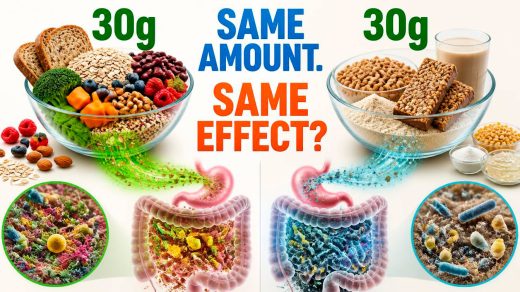

You can eat plenty of calories and still feel hungry surprisingly soon. The reason is that your appetite responds to far more than calories alone.
You finish lunch. It wasn’t tiny. Maybe you even glanced at the calories and thought, That should definitely hold me for a while.
Then, an hour later, you’re thinking about food again.
It’s easy to read that hunger as evidence that something went wrong: the meal was too small, your appetite is unusually large, or you simply lack self-control.
But there is another explanation:
A meal can contain plenty of energy without producing much lasting satiety.
Calories tell you how much energy food contains. They don’t tell you exactly how your stomach, intestines, brain, and senses will respond to that food—or how long you’ll feel satisfied afterward.
That is why two meals with similar calories can leave you feeling very different an hour later.
The more useful question isn’t simply “Did I eat enough?”
It’s “What did those calories come packaged in?”
Calories Don’t Come With a Fullness Guarantee
There are actually two related experiences hiding inside what we casually call “feeling full.”
Satiation is what helps you stop eating during a meal. Satiety is what happens afterward—the period when hunger stays low and you’re not particularly interested in eating again.
Neither is controlled by a calorie counter.
As you eat, your brain receives information from the digestive system about the physical presence of food and the nutrients arriving with it. Taste, smell, texture, learned expectations, and the rewarding qualities of food also influence the experience.
Now imagine 500 calories arriving in two very different forms.
One meal might concentrate those calories into a relatively small amount of food that’s soft and quick to eat. Another might provide a larger volume of food with more water, protein, fiber, and texture.
The calorie count can be similar. Your experience of those meals doesn’t have to be.
That doesn’t make calories irrelevant to appetite. It simply means there is no reliable equation in which a certain number of calories buys you a certain number of hunger-free hours.
What Makes Some Meals More Filling?
No single nutrient controls fullness. But several characteristics of a meal can change the way appetite responds.
Protein is one of the better-supported examples. A meta-analysis of controlled studies found that higher-protein conditions generally produced greater feelings of fullness than lower-protein conditions, although the researchers cautioned against assuming those findings translate neatly into every real-world meal.
Fiber is less predictable than its reputation suggests.
In a systematic review covering 107 short-term fiber treatments, only 39% significantly reduced subjective appetite compared with controls. The effect depended on the fiber source and the food containing it.
So “fiber keeps you full” is a useful shorthand, not a universal rule. An intact fiber-rich food and a highly refined product with some added fiber shouldn’t automatically be expected to affect appetite in the same way.
Then there is something much easier to see: how much physical food those calories occupy.
Foods high in water generally have lower energy density—they provide fewer calories per gram of food. In a meta-analysis of 38 randomized studies, lowering the energy density of meals substantially reduced calorie intake even though the amount of food people ate by weight changed very little.
That doesn’t mean stomach volume alone determines hunger. It shows why the body can experience two equally caloric meals differently.
Physical form matters too. Research comparing liquids, semisolids, and solids suggests that calories consumed in liquid form are sometimes compensated for less completely at later eating occasions, although the effect varies considerably with the food, timing, and experimental conditions.
That’s why “liquid calories don’t fill you up” is too simplistic. Soup, a smoothie, a sugary drink, and a liquid meal replacement are all liquids, but they are not nutritionally or physiologically interchangeable.
The larger point is more useful than any single food rule:
Your appetite responds to the architecture of the meal, not just its calorie total.
A High-Calorie Meal Can Still Be Surprisingly Easy to Eat
This is where calorie intuition becomes especially unreliable.
Some foods pack substantial energy into relatively little weight or volume. Some are soft and quick to eat. Some combine properties that make continued eating particularly easy.
That means a lot of energy can arrive before the meal feels proportionally substantial.
Eating speed illustrates the disconnect. A meta-analysis of experiments that deliberately changed how quickly people ate found that slower eating reduced how much food energy people consumed. Yet it did not produce a clear reduction in reported hunger afterward.
In other words, how much you eat and how hungry you feel do not always move together neatly.
An NIH inpatient experiment made the same broader point in a more striking way. Twenty adults spent two weeks eating an ultra-processed diet and two weeks eating an unprocessed diet, in random order, while being allowed to eat as much or as little as they wanted.
The meals offered in the two diets were matched for several nutritional characteristics. Yet participants consumed about 500 more calories per day during the ultra-processed phase, ate faster, and gained weight; during the unprocessed phase, they lost weight.
That experiment does not prove that every ultra-processed food somehow bypasses fullness, nor does it identify “processing” itself as the single explanation. The foods differed in multiple ways, and the researchers specifically noted that further work was needed to identify what drove the difference.
What it does demonstrate is something more relevant to everyday hunger:
Foods that look similar on a nutrition label can produce very different eating behavior.
A label sees calories, grams, and percentages.
Your appetite encounters an actual food.
Sometimes It’s Not Just the Meal
Now imagine eating exactly the same lunch on two different days.
On Monday, it carries you comfortably to dinner.
On Thursday, you’re searching for a snack much sooner.
The meal didn’t necessarily stop “working.” Your appetite also reflects what was happening before you ate it.
Maybe Thursday followed a more physically demanding morning. Maybe breakfast was smaller. Perhaps you hadn’t eaten much the previous evening. Or maybe you slept badly.
Sleep is a particularly good example.
A meta-analysis of randomized trials found that restricting sleep increased both subjective hunger and daily energy intake. But it did not find strong evidence for the popular simplified explanation that average changes in the appetite hormones leptin and ghrelin account for the effect.
Physical activity can also alter appetite, but not identically in everyone or after every type of exercise. Stress can change appetite too, sometimes in opposite directions depending on the person and situation.
So asking whether a meal is objectively “filling” can take you only so far.
Appetite emerges from an interaction between the food and the person eating it that day.
That is also why one afternoon of unexpected hunger usually tells you very little. Hunger isn’t a score telling you whether you constructed your lunch correctly.
What Is Worth Noticing If This Keeps Happening?
If you repeatedly eat what seems like a substantial meal and feel hungry again surprisingly soon, look for the pattern before blaming your appetite.
Start with the meal itself.
Was a lot of its energy concentrated into a relatively small amount of food? Did it contain a meaningful protein source? Did it include fiber-rich, water-rich foods that added physical volume? Was much of the energy in a beverage? Was it unusually quick and easy to eat?
Then widen the frame.
Had you eaten less earlier that day? Had your activity changed? Were you short on sleep? Was something else different from the days when a similar meal kept you satisfied?
These aren’t rules for building a “perfect” meal. They’re clues that can explain why equal calories do not necessarily produce equal fullness.
And they’re more useful than treating hunger as a failure of willpower.
There is one important boundary, however.
Ordinary fluctuations in appetite are common. But a new, unusually intense, or persistent increase in hunger without an obvious explanation deserves more attention, particularly when it appears with other symptoms.
Increased hunger can occur with diabetes, for example, where it may accompany increased thirst and urination, fatigue, blurred vision, or unexplained weight loss. Hyperthyroidism can cause weight loss despite increased appetite and may also cause a rapid or irregular heartbeat, shakiness, sweating, and difficulty tolerating heat.
That doesn’t mean wanting another sandwich after lunch is evidence of a medical condition. It means a substantial, unexplained change in appetite—especially alongside other symptoms—is worth discussing with a healthcare professional rather than automatically treating it as a food-choice problem.
So why can you finish a perfectly substantial meal and find yourself back in the kitchen an hour later?
Because your body never experienced lunch as a number printed on a label.
It experienced the meal’s protein, fiber, water, volume, texture, physical form, and sensory qualities. It experienced how quickly you ate it. And it experienced all of that against the background of your sleep, activity, previous meals, and current physiological state.
The contradiction disappears once you stop expecting calories and fullness to be interchangeable.
A meal can provide plenty of energy without providing much lasting satiety.
The useful question isn’t whether your hunger is somehow wrong. It’s what the meal—and the day surrounding it—may be telling you.