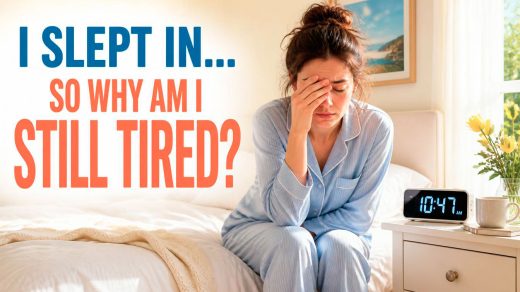

That familiar 2 p.m. energy crash might have less to do with lunch than you think. Your body has a natural dip in alertness—even when you’ve slept well.
You slept through the night. Woke up feeling rested. Had a perfectly productive morning.
Then 2:30 p.m. arrives.
Suddenly, you’re reading the same paragraph twice. Concentrating takes more effort, your eyelids feel heavy, and closing your eyes for a few minutes sounds incredibly appealing.
What happened to all that energy you had this morning?
You got a full night’s sleep. You haven’t done anything particularly exhausting. Yet your brain seems ready for another round of rest.
The obvious suspect is lunch.
Maybe you ate too much. Maybe the carbohydrates made you sleepy. Maybe your blood sugar dropped.
But here’s something surprising:
Scientists have observed the afternoon slump even in people who haven’t eaten lunch.
That’s because feeling awake isn’t determined entirely by how much sleep you got—or what you ate a few hours ago.
Your body has a built-in daily rhythm that changes how strongly it promotes alertness.
And for many people, the early afternoon is a natural low point.
The Afternoon Slump Isn’t Necessarily Caused by Lunch
That familiar wave of tiredness after midday is often called the post-lunch dip.
The name makes the explanation seem obvious.
You eat lunch. You get sleepy. Therefore, lunch must be responsible.
But researchers have found that the relationship isn’t so straightforward.
Sleep scientist Timothy Monk explored this phenomenon in a 2005 review published in Clinics in Sports Medicine. He described evidence that people can experience a measurable decline in afternoon performance even without eating lunch—and, in some experiments, without knowing what time it is.
That second detail is particularly revealing.
If someone becomes less alert without a conventional midday meal or awareness of the clock, the effect can’t be explained entirely by digestion or the expectation of feeling tired after lunch.
An earlier experiment by Monk and colleagues demonstrated the point.
In the 1996 study, researchers followed 12 participants performing a repetitive attention task at different times of day.
Instead of serving a conventional lunch, they provided small liquid nutritional supplements throughout the day.
Five participants still showed a distinct afternoon drop in performance.
The other seven didn’t.
The difference was associated with characteristics of their daily body-temperature rhythms, suggesting that biological timing contributed to the effect.
This was a small experiment, not proof that everyone experiences the same afternoon slump.
But it demonstrated something important:
Removing lunch doesn’t necessarily remove afternoon sleepiness.
Food can contribute to feeling drowsy. Yet the body’s natural regulation of alertness may already be making that part of the day more vulnerable to sleepiness.
Which leads to the more interesting question: Why would your body become less alert when you’ve already had enough sleep?
Your Brain Doesn’t Stay Equally Alert All Day
It’s tempting to think of sleep like charging a battery.
You sleep overnight, wake up fully charged, and gradually use that energy until bedtime.
But human alertness doesn’t follow such a simple downward slope.
Instead, two major biological processes interact throughout the day.
The first is sleep pressure.
Sleep pressure is the growing drive to sleep that develops the longer you remain awake.
After a sufficient night’s sleep, that pressure is relatively low.
As the hours pass, it gradually increases.
So even if you wake up feeling completely refreshed, your body isn’t in the same state eight hours later. You’ve been awake all morning, and the biological drive for sleep has been building.
The second process is your circadian rhythm.
Your internal biological clock helps regulate when your body promotes wakefulness and when it becomes more inclined toward sleep.
But that wakefulness signal isn’t equally strong throughout the day.
For many people following a typical daytime schedule, circadian support for alertness temporarily weakens during the early afternoon.
Now put the two processes together.
Sleep pressure has been increasing since morning.
At the same time, your internal clock becomes temporarily less effective at keeping that pressure in check.
The result can be a noticeable increase in sleepiness—even after a perfectly adequate night’s sleep.
The Centers for Disease Control and Prevention’s National Institute for Occupational Safety and Health (NIOSH) describes this interaction as a natural afternoon dip in wakefulness.
For people on conventional daytime schedules, the vulnerable period often falls around 2–5 p.m.
That doesn’t mean everyone suddenly becomes sleepy at exactly 2 p.m.
The timing varies with individual biological rhythms, sleep schedules, and other circumstances.
And it doesn’t mean everyone needs an afternoon nap.
It simply explains why your alertness can decline temporarily without anything necessarily being wrong.
Getting enough sleep reduces sleep pressure. It doesn’t eliminate the body’s natural daily rhythms.
Why Some Afternoon Slumps Feel Worse Than Others
If the afternoon dip is partly biological, why do some people barely notice it while others struggle to keep their eyes open?
Because your internal clock isn’t acting alone.
Several factors can make that natural decline more noticeable.
Last night’s sleep can make the dip stronger
Even after a reasonably good night, sleep pressure builds throughout the day.
But if you’ve slept too little over several nights, you may already be carrying extra sleep pressure into the afternoon.
When your circadian alertness temporarily decreases, that additional pressure can make the slump feel considerably stronger.
And spending eight hours in bed doesn’t necessarily mean you obtained eight hours of restorative sleep.
Frequent awakenings or other disruptions can leave you sleepier the following day, even when the time spent in bed looked sufficient.
Lunch can add to the sleepiness
Although lunch isn’t necessary for an afternoon slump to occur, eating can influence how sleepy you feel.
Small controlled experiments have found that consuming a meal can increase the tendency to fall asleep compared with drinking water alone.
In one 1997 study published in Physiology & Behavior, researchers measured how quickly participants fell asleep during scheduled nap opportunities after different meal conditions.
Participants generally fell asleep more quickly after consuming a solid meal than after an equivalent volume of water.
Interestingly, the researchers didn’t find significant differences between the different meal compositions tested.
The experiments were small, so they don’t establish that all meals affect everyone equally.
But they suggest something useful:
Lunch may make an existing afternoon tendency toward sleepiness more noticeable rather than being its sole cause.
That also challenges the idea that an afternoon energy crash must be caused by a sudden blood sugar drop.
Blood glucose normally changes after eating. Feeling sleepy in the afternoon doesn’t, by itself, establish that your blood sugar has fallen abnormally.
Your surroundings can make the dip harder to ignore
Picture yourself sitting in a quiet room, working through a repetitive task.
The room is comfortable. Nothing particularly interesting is happening. You’ve been staring at the same screen for an hour.
As your natural alertness decreases, staying focused may become noticeably harder.
Now imagine spending that same period doing something engaging and interactive.
You may still be experiencing the underlying biological dip, but the sleepiness might be less obvious.
NIOSH identifies monotonous tasks as one factor that can contribute to reduced alertness.
Individual differences matter too. Some people have a pronounced afternoon decline, while others experience only a mild change.
Your internal clock helps set the stage, but sleep quality, meals, and daily activities influence how strongly you feel the effect.
That explains why your afternoon slump may be barely noticeable one day and difficult to ignore the next.
When Is Afternoon Sleepiness More Than a Normal Slump?
Feeling somewhat drowsy during the afternoon isn’t automatically a health problem.
You might notice that concentrating takes more effort, that your attention occasionally drifts, or that a brief rest sounds appealing.
The feeling passes, and you’re able to continue your normal activities.
That’s different from excessive daytime sleepiness.
There’s also a useful distinction between sleepiness and fatigue.
Fatigue can mean feeling physically or mentally exhausted without necessarily being likely to fall asleep.
Sleepiness involves an increased tendency to doze off.
The two can overlap, but they aren’t identical.
A temporary reduction in alertness during the afternoon is one thing.
Regularly struggling to stay awake during ordinary activities is another.
Sleepiness deserves medical attention when it becomes persistent, unexpectedly severe, progressively worse, or begins interfering with everyday life.
Examples include repeatedly falling asleep unintentionally or having difficulty remaining awake despite allowing enough time for nighttime sleep.
Loud snoring, gasping during sleep, or witnessed pauses in breathing may also be relevant. Conditions such as sleep apnea can disrupt sleep quality and contribute to significant daytime sleepiness.
Insufficient sleep, certain medications, and other medical conditions can also play a role.
The time of day alone cannot determine whether sleepiness is normal or signals an underlying problem.
And if you’re struggling to stay awake while driving or performing another safety-sensitive activity, stop the activity rather than assuming it’s just an ordinary afternoon dip.
The meaningful distinction isn’t whether you ever feel sleepy at 2 p.m.
It’s whether the sleepiness is temporary and manageable—or persistent enough to interfere with normal functioning and safety.
So Why Do You Feel Sleepy at 2 or 3 p.m.?
Return to that familiar afternoon.
You slept reasonably well. Your morning was productive. Then, almost predictably, your concentration began to fade.
Perhaps lunch contributed.
Perhaps the previous night’s sleep wasn’t quite as restorative as you thought.
But there’s another explanation that’s easy to overlook.
Your body doesn’t maintain the same level of alertness throughout the day.
Sleep pressure builds while you’re awake, and your internal clock changes how strongly it promotes wakefulness.
For many people, those two processes create a recognizable afternoon period when staying focused takes more effort.
That doesn’t mean the body has run out of energy, that lunch was unhealthy, or that you necessarily need more nighttime sleep.
Sometimes, the explanation is simply the timing of your biology.
A full night’s sleep can leave you well rested without making you equally alert at every hour of the following day.