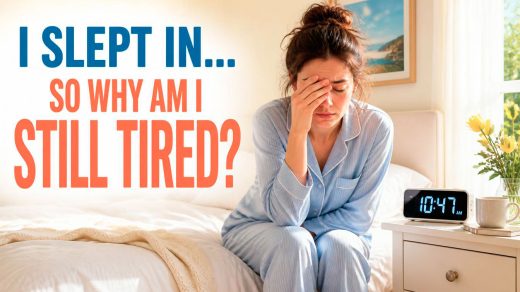

Waking up is not necessarily the problem. What wakes you, how long you stay awake, and how you feel the next day matter much more.
You fall asleep without much trouble. Then, for no obvious reason, you are awake in a dark room.
You check the clock: 3:07 a.m.
The next night, it happens again. Maybe not at exactly 3:07, but close enough to make you wonder: Why can’t my body just stay asleep?
The surprising answer is that perfectly continuous sleep was never really the standard.
Sleep is a changing biological state. Your brain cycles through different stages throughout the night, and brief arousals occur along the way. Many are so short that you never remember them.
So waking during the night does not automatically mean something is wrong.
The more revealing question is: Why did you become awake enough—and stay awake long enough—to notice?
That distinction separates an ordinary feature of sleep from a pattern worth paying attention to.
Waking Up Doesn’t Necessarily Mean You’re Sleeping Badly
Sleep can feel like one uninterrupted stretch when you remember it the next morning. Biologically, it is much more eventful.
Across the night, your brain repeatedly moves among different stages of non-REM and REM sleep. Brief arousals can occur during those transitions and at other points during sleep.
An arousal in sleep research does not necessarily mean the experience of lying awake and staring at the ceiling. It can be a very brief shift in brain activity that never becomes a remembered period of wakefulness.
Sometimes, though, an arousal crosses the threshold into awareness.
A sound catches your attention. You become too warm. You notice discomfort. You realize you could use the bathroom. A thought about tomorrow arrives. Or you simply remain awake long enough to register what is happening.
Now you have an awakening you can remember.
There is no universal number of remembered awakenings that cleanly divides normal from abnormal sleep. Sleep patterns vary with age, health, circumstances, and the individual. Normal aging itself tends to bring more nighttime awakenings and more time awake after sleep onset, although persistent poor sleep should not simply be dismissed as an inevitable part of getting older.
That is why waking during the night and having trouble maintaining sleep are not the same thing.
If you briefly wake, turn over, and fall asleep again, the awakening itself may matter very little.
If you repeatedly wake and then spend substantial stretches unable to return to sleep, the story changes.
The Pattern Matters More Than the Awakening
Imagine two people who both wake at 2:30 a.m.
One rolls over and soon falls asleep again. The other becomes fully alert, starts thinking about tomorrow, checks the clock several times, and remains awake for what feels like forever.
The clock records the same event: both woke up.
Their sleep problems are clearly not the same.
Four details make nighttime waking much more informative: how often it happens, how long you stay awake, what accompanies the awakening, and how you function the next day.
Persistent difficulty staying asleep can be one form of insomnia. But insomnia is more than simply remembering that you woke during the night. The problem becomes more clinically meaningful when difficulty sleeping persists despite adequate opportunity for sleep and is accompanied by distress or impaired daytime functioning.
The surrounding symptoms can also provide clues.
Repeated awakenings accompanied by loud habitual snoring, gasping, choking, or witnessed pauses in breathing raise a different question from awakenings associated with pain, reflux, hot flashes, urinary urgency, or an uncomfortable urge to move the legs.
Even then, what you notice after waking is not necessarily what originally woke you.
Consider the bathroom trip. Sometimes a full bladder disrupts sleep. But people can also wake for another reason, notice their bladder once they are awake, and then decide to get up. Research on nighttime urination recognizes this distinction, which is why “I woke up and went to the bathroom” does not necessarily mean “my bladder woke me up.”
The awakening is often only the beginning of the investigation.
What Turns a Brief Awakening Into a Long One?
Sometimes the trigger is remarkably ordinary.
A bedroom becomes too warm. Traffic passes outside. A partner moves. Pain flares. Reflux becomes noticeable. A hot flash occurs. Any of these can push you from sleep into awareness.
Menopausal hot flashes are a good example of how a physical event can interact with sleep. Studies using objective sleep measurements have found that many nighttime hot flashes occur alongside awakenings, although the relationship is not identical in every person or every episode.
Sleep disorders can create their own patterns.
Obstructive sleep apnea can repeatedly disturb sleep as breathing becomes impaired during the night. Restless legs syndrome has a different signature: an urge to move the legs, often with uncomfortable sensations, that begins or worsens during rest, is relieved by movement, and tends to be worse in the evening or at night.
But sometimes the most important part happens after the awakening.
You wake because of a sound.
Then you remember tomorrow’s meeting.
Then you check the clock.
It’s 3:18. If I fall asleep right now, I can still get…
The original disturbance may already be gone. But now your attention is fixed on being awake, how much sleep you are losing, and how bad tomorrow might feel.
The problem has shifted from something woke me to why can’t I fall back asleep?
That is one reason the same minor disturbance can be forgotten on one night and become a frustrating hour of wakefulness on another.
Why Does It Keep Happening Around 3 a.m.?
Few nighttime awakenings attract more explanations than waking at 3 a.m.
Online, that particular hour can acquire almost mystical biological significance: a specific hormone, organ, blood-sugar change, or hidden health problem supposedly switches on at exactly the wrong moment.
Human sleep is not organized that neatly.
There are legitimate reasons waking may become easier at different points in the night. The pressure to sleep that accumulated while you were awake gradually declines as the night progresses. The mixture of sleep stages changes too, with deeper slow-wave sleep concentrated more heavily earlier in the night and REM sleep becoming more prominent later.
Your circadian system is changing at the same time.
So sleep at 3 a.m. is not physiologically identical to sleep shortly after bedtime. But that does not create a universal biological rule in which waking at one clock time points to one particular cause.
Recurring timing can have much simpler explanations.
If you generally go to bed at similar times, parts of your sleep pattern will also occur at roughly similar times. Repeated disturbances—such as environmental noise, temperature changes, physical symptoms, or another person’s schedule—can follow patterns too.
And once you start checking the clock, the time itself becomes memorable.
Wake briefly without looking and you may forget the episode by morning. Wake, see 3:12 a.m. again, and suddenly the event feels like evidence of a pattern. After several nights, you may even begin anticipating it.
The timing can still be useful context, particularly if awakenings consistently coincide with another symptom or event.
But 3 a.m. is a clue, not a diagnosis.
What Should You Pay Attention to?
If repeated waking is bothering you, tracking every movement and minute of sleep can create more noise than useful information.
A simpler set of questions tells you more:
How often does it happen? How long am I awake? What is happening around the awakening? How do I feel and function the next day?
Those questions distinguish very different situations.
Occasionally becoming aware that you are awake and then drifting back to sleep is not the same as repeatedly spending long periods unable to return to sleep.
Likewise, an unexplained brief awakening is different from repeatedly waking while gasping or choking, being told that your breathing stops during sleep, experiencing significant pain or reflux, having bothersome nighttime urinary symptoms, waking with hot flashes, or experiencing the characteristic nighttime urge to move your legs.
The daytime consequences matter too.
If repeated difficulty staying asleep is regularly affecting alertness, concentration, energy, mood, or everyday functioning, the fact that nighttime awakenings can be normal is no longer very reassuring. The persistent pattern is worth discussing with a healthcare professional.
That is especially important when another recognizable symptom accompanies the awakenings, because the appropriate response depends on what is actually disrupting the sleep.
And that brings the 3:07 a.m. awakening into perspective.
Waking up does not by itself mean your sleep is malfunctioning. Normal sleep contains transitions, brief arousals, and occasional periods of wakefulness. With age, sleep can become somewhat more fragmented as well.
But “waking up is normal” should not become a reason to dismiss a persistent problem.
If awakenings are frequent or prolonged, returning to sleep is repeatedly difficult, other symptoms accompany them, or your days are suffering, the useful question is no longer:
“Why did I wake up?”
It is:
“What keeps turning a normal awakening into disrupted sleep?”
The clock time may be the detail you notice first. The pattern around it usually tells you much more.