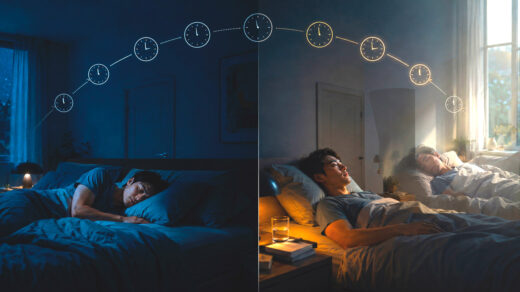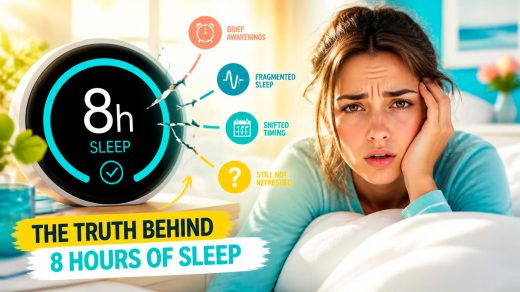

Your wearable can reveal useful patterns — but some of its most precise-looking numbers are estimates, not direct measurements.
You wake up feeling pretty good.
Then you check your wrist.
Sleep score: 68. Deep sleep: disappointing. REM: not much better.
Nothing about the night has changed, but suddenly it feels as though you slept badly.
That moment captures the strange power of sleep trackers. They turn an invisible biological process into clean graphs, percentages, stages, and scores—and those numbers can look far more certain than the technology behind them actually is.
That does not make sleep trackers useless. The better question is:
Accurate enough for what?
Wearables can be genuinely useful for seeing when you tend to sleep, roughly how long you sleep, and whether your schedule is changing over time. But detailed sleep stages and all-in-one sleep scores require much more caution.
The reason becomes clear once you understand what the device is actually measuring.
Your Watch Doesn’t Actually See You Sleeping
Most wrist-worn sleep trackers directly sense things such as movement and pulse-related signals. They may use an accelerometer to detect motion and optical sensors to estimate heart rate and related cardiovascular patterns.
From those signals, software tries to infer what happened during the night.
In simple terms:
signals from your wrist → algorithm → estimated sleep
That last word matters.
When an app says you spent 72 minutes in REM sleep, the watch generally did not directly observe 72 minutes of REM. It measured signals at your wrist and classified periods of the night according to patterns its algorithm associates with REM.
A clinical sleep study works very differently.
Polysomnography, or PSG, records signals that can include brain activity, eye movements, muscle activity, breathing, heart activity, and blood oxygen. Those measurements give clinicians a much more direct view of sleep and are used when detailed sleep characterization or diagnosis is needed.
A typical consumer wearable has a narrower window into what your body is doing.
That is why a beautifully precise chart can still contain a surprising amount of estimation.
The Most Important Question: Which Number Are You Looking At?
There is no single answer to “Are sleep trackers accurate?”
Accurate at telling sleep from wakefulness? Maybe reasonably so.
Accurate at estimating total sleep time? Often useful, but imperfect.
Accurate at reconstructing every REM and deep-sleep period? Much harder.
Recent evidence makes that distinction especially clear.
A 2026 systematic review and meta-analysis comparing wearables with laboratory PSG in healthy adults found that consumer devices could provide useful estimates of broader sleep measures, but performance varied substantially and detailed sleep-stage tracking remained inconsistent. The authors concluded that wearables may have value for longer-term monitoring, but they should not be treated as replacements for PSG.
In other words, the tracker may be most useful when you ask it a broad question—and least trustworthy when you demand laboratory-level precision.
Sleep versus awake
Wearables tend to be better at recognizing sleep than at recognizing wakefulness.
A 2025 laboratory study compared six commercial wrist-worn devices with PSG in 62 adults. All six correctly detected more than 90% of periods that PSG classified as sleep. But their ability to correctly recognize wakefulness was much lower, with specificity ranging from about 29% to 52%.
That helps explain a familiar discrepancy.
Suppose you wake at 4:30 a.m. and lie quietly for half an hour. You know you were awake. But if you barely move and your cardiovascular signals resemble sleep, your wearable has a much harder classification problem.
The result may be a night that looks more continuous on the app than it felt in real life.
That does not necessarily mean you remembered the night incorrectly. It may mean the device mistook quiet wakefulness for sleep.
Total sleep time and sleep schedule
This is where sleep tracking can become much more useful.
A wearable does not need to get every minute right to reveal that you routinely sleep less on workdays than weekends, that your bedtime has drifted later, or that your sleep window has shortened over the past month.
The 2026 review supports this kind of longitudinal use while also showing that devices can systematically over- or underestimate certain sleep measures.
So think of total sleep time as an estimate with context, not a stopwatch reading.
If your tracker says you slept 6 hours 55 minutes when a lab would have measured something somewhat different, that matters if you are conducting a clinical study.
It may matter much less if the real discovery is that you have been getting roughly six-and-a-half to seven hours every weeknight for the past month.
The pattern can still be informative even when the individual measurements are imperfect.
REM and Deep Sleep Deserve More Skepticism
Sleep-stage charts are often the most fascinating part of a tracking app.
They are also where precision becomes harder to justify.
Separating sleep from wakefulness is already an inference. Dividing the night further into wake, REM, light sleep, and deep sleep requires the algorithm to make finer distinctions from limited signals.
Clinical sleep staging relies heavily on brain electrical activity along with eye and muscle signals. Most wrist wearables do not measure that same combination directly.
The difference shows up in validation studies.
In the 2025 six-device study, agreement with PSG for multi-stage sleep classification ranged only from fair to moderate, and performance differed substantially across devices.
The 2026 systematic review similarly found mixed sleep-stage performance and substantial variability.
That does not mean your stage graph contains no information.
It means 47 minutes of deep sleep should not be treated as though 47 minutes were directly measured by brain electrodes.
A large, repeated change might be worth noticing. Tiny differences from one night to the next deserve much less confidence.
Your Sleep Score Is Even Further Removed From Direct Measurement
The sleep score may be the most psychologically persuasive number on the screen.
It is also one of the easiest to misunderstand.
There is no biological quantity called a “sleep score” circulating through your body.
The score is created by software.
A company may combine estimated sleep duration, timing, awakenings, sleep stages, movement, heart-rate patterns, or other measurements and then weight them according to its own formula.
So the chain may look more like this:
measured signals → estimated sleep metrics → calculated score
By the time you see a 72, several layers of interpretation may already be involved.
And because consumer sleep algorithms are often proprietary, researchers cannot always see exactly how a company transforms raw signals into the final number. Commercial algorithms and hardware can also change over time.
That makes a sleep score useful mainly as a summary within its own system.
A score of 82 is not necessarily biologically “10 points better” than a 72. Nor should you expect two brands to grade the same night identically.
Think of the number as your device’s interpretation of the night—not a medical grade for your sleep.
The Tracker’s Real Strength May Be What Happens Over Weeks
Once you stop asking a wearable to behave like a miniature sleep laboratory, its strongest feature becomes easier to appreciate.
It keeps paying attention.
Most people cannot accurately reconstruct their sleep timing for the past three months from memory. A wearable can quietly collect estimates night after night.
That can make patterns visible.
Perhaps your bedtime gradually moves later during busy weeks.
Perhaps weekends shift your schedule by several hours.
Perhaps the amount of time available for sleep has been shrinking without you fully noticing.
Perhaps what felt like “an occasional bad night” is happening four nights a week.
This is the kind of information wearables may be particularly well suited to provide. The 2026 review specifically identified longitudinal monitoring as a potentially useful role for the technology despite its limitations compared with PSG.
Your own baseline may also be more useful than someone else’s number.
If you use the same device consistently and your usual pattern changes for several weeks, that shift may deserve attention even if the absolute measurements are imperfect.
But trends still need interpretation.
If your tracker shows more deep sleep after exercise, less REM during a stressful week, or a better score after changing your evening routine, you have observed a correlation.
You have not necessarily discovered the cause.
The sleep stage itself may be estimated, other things may have changed, and a consumer tracker alone cannot establish why the difference occurred.
The best role for the device is therefore closer to a data-rich diary than an all-knowing judge.
When More Sleep Data Becomes Less Helpful
There is another problem that has nothing to do with sensor accuracy.
Sometimes the numbers themselves become the problem.
In 2017, sleep clinicians described patients who had become intensely focused on perfecting their wearable sleep data. They coined the term orthosomnia for this pattern of preoccupation with achieving “correct” sleep according to a tracker. The paper described a clinical phenomenon rather than establishing that trackers generally cause sleep disorders.
The trap is easy to imagine.
You wake feeling fine.
The tracker says your sleep was poor.
You start wondering why.
The next night, you try harder to sleep “correctly.”
You check the score again the following morning.
Soon, normal variation begins to feel like failure.
For many people, sleep tracking will never become this consuming. But if checking the data repeatedly makes you more anxious about sleep, the tracker may no longer be helping you understand anything useful.
One night’s disappointing graph does not automatically deserve a response.
And if you feel rested and function well during the day, an algorithm should not single-handedly persuade you that your night was a disaster.
What a Consumer Sleep Tracker Cannot Tell You
There is one boundary worth making very clear:
ordinary consumer sleep tracking is not the same as a clinical sleep evaluation.
The American Academy of Sleep Medicine has stated that consumer sleep technologies should not be used on their own to diagnose or treat sleep disorders without appropriate validation and clinical evaluation.
That warning works in both directions.
An ugly sleep-stage graph does not diagnose a disorder.
A reassuring score does not prove that nothing is wrong.
Persistent symptoms still matter.
Frequent loud snoring, gasping during sleep, breathing that repeatedly stops and restarts, and significant daytime sleepiness are among the symptoms that can occur with sleep apnea and may warrant medical evaluation.
That is one reason clinical testing measures much more than an ordinary sleep score.
Some modern wearables do contain specific health features that have been separately validated or reviewed for particular uses. Those features should be judged according to the evidence and intended purpose of that individual feature.
But one medically validated function does not automatically make every REM estimate, deep-sleep total, or proprietary sleep score on the same device a clinical measurement.
So What Should You Actually Pay Attention To?
You do not need to ignore your sleep tracker.
You just need to give different numbers different amounts of trust.
Pay more attention to repeated patterns. Changes in your usual sleep timing, approximate duration, or consistency over weeks are often more informative than one night’s score.
Treat precise sleep stages as estimates. REM and deep-sleep numbers may contain useful information, but they are not equivalent to laboratory sleep staging.
Treat the score as a shortcut. It can help you notice that something changed, but it does not deserve the authority of a diagnosis—or even necessarily the final word on whether you slept well.
Add the information the tracker cannot measure well. Do you feel rested? Are you alert during the day? Has your schedule changed? Is the pattern persistent?
And perhaps most importantly:
Do not let the tracker answer a medical question it was never designed to answer.
Your Watch Can Be Useful Without Being Right About Everything
Sleep trackers occupy an unusual middle ground.
They are more informative than guessing. Less definitive than a sleep lab.
That is not a weakness so much as a clue to how they should be used.
They can help you notice whether you are giving yourself enough time to sleep, whether your schedule is drifting, and whether your patterns are changing. Research suggests those broader signals can be useful, especially when collected over time.
But the further the device moves from signals it directly measures toward detailed sleep stages and proprietary scores, the more interpretation enters the picture.
So if you want one rule for reading tomorrow morning’s sleep report, use this:
Trust the pattern more than the decimal point.
Your tracker can help you understand your sleep.
It just should not get the only vote.