Your circadian system does much more than make you sleepy at night. It helps organize when your body is prepared for sleep, alertness, eating, activity, and other biological processes.
Some days, your body seems to know the time before you do.
You get sleepy around the same hour each evening. Wake a few minutes before the alarm. Hit a familiar dip in alertness during the day.
Then you fly several time zones away, work through the night, or stay up much later than usual—and suddenly sleepiness, hunger, and alertness seem to be following a schedule that has little to do with the clock on the wall.
We usually explain this with two words: body clock.
But your body clock is not simply a sleep timer. It is part of a biological timing system that helps organize roughly 24-hour rhythms throughout the body. Sleep and wakefulness are among its most noticeable effects, but circadian timing also influences patterns in melatonin, body temperature, cortisol, metabolism, and many other physiological processes.
And it does not work alone.
How sleepy you feel at 11 p.m. depends partly on your circadian timing, partly on how long you have been awake, and partly on the schedule you are trying to keep.
Usually, those forces cooperate.
You notice your body clock most when they don’t.
Your Body Is Not Doing the Same Thing at Every Hour
A circadian rhythm is an internally generated biological cycle that runs roughly every 24 hours. Environmental signals—especially light—help keep these rhythms synchronized with the outside world.
That does not mean the clock dictates everything your body does.
Eat a meal and your metabolism responds. Exercise and your heart rate rises. Fall asleep and numerous physiological processes change. Researchers use carefully controlled experiments precisely because ordinary behavior can obscure the rhythms generated by circadian timing itself.
The useful idea is simpler:
Your biology changes with time of day.
Melatonin typically rises during the biological evening. Core body temperature follows a daily rhythm. Cortisol has a strong circadian pattern. Metabolic responses also vary across biological time.
In other words, noon and midnight are not biologically interchangeable—even if you have been awake for the same number of hours.
There Isn’t Just One Clock
At the center of the circadian system is a tiny region of the brain called the suprachiasmatic nucleus, or SCN. Located in the hypothalamus, it acts as the body’s central circadian pacemaker and receives timing information from light entering the eyes.
But circadian timing is not confined to the brain.
Cells throughout the body contain molecular clock machinery. The liver, muscle, fat tissue, and other organs show rhythmic activity that can be coordinated by the central clock while also responding to behaviors such as eating and physical activity.
This is sometimes translated into wellness language about getting your organs “out of sync.” There is real biology behind the concept, but the consumer version often outruns what can actually be measured or interpreted.
There is no ordinary home test that can meaningfully tell you your liver clock is three hours behind your brain.
What researchers can say much more confidently is that different signals affect different parts of the circadian system.
And for the central clock, one signal matters more than any other.
Light Is Your Clock’s Most Powerful Time Cue
Light does more than make vision possible.
Specialized light-sensitive cells in the eyes send information about the light-dark cycle to the circadian system. That information helps your internal timing stay synchronized with the 24-hour day.
But “get light to reset your clock” is too simple.
The circadian effect of light depends on when you receive it, how bright it is, how long it lasts, its spectrum, your recent light exposure, and your individual sensitivity.
Most importantly, timing can change the direction of the effect.
Light at certain biological times tends to shift circadian timing later. Light at others can shift it earlier. This relationship—known as a phase-response curve—is one reason carefully timed bright light can be used clinically for some circadian sleep-wake disorders.
That makes “morning light shifts your clock earlier” a useful generalization, not a universal rule based solely on wall-clock time. Your biological morning depends on where your internal clock currently sits.
People also differ dramatically in light sensitivity. In one laboratory study, the amount of evening light needed to produce a similar degree of melatonin suppression varied by more than fiftyfold among participants.
And this is why blaming everything on blue light misses much of the story.
Wavelength matters. So do brightness, timing, duration, and the rest of your light environment.
Your circadian system is responding to a pattern, not reading the marketing label on your light bulb.
Being Tired and Being Circadian-Ready for Sleep Are Different Things
This is one of the most useful ideas in sleep science.
Your circadian system helps influence when your biology favors sleep or alertness.
Another process tracks how long you have been awake.
This is the foundation of the classic two-process model of sleep regulation. Sleep pressure builds as wakefulness continues and falls during sleep. Meanwhile, circadian signals rise and fall according to biological time.
The interaction explains several experiences that otherwise seem contradictory.
You can be exhausted after a long day, then suddenly feel more alert late in the evening. Sleep pressure may be high while circadian alerting temporarily pushes in the opposite direction.
You can wake too early after insufficient sleep yet struggle to fall back asleep as your circadian system begins promoting daytime wakefulness.
And during jet lag, you can be extremely tired while your internal night is still badly mismatched with local time.
Scientists continue to refine exactly how sleep homeostasis and circadian timing interact, but the practical lesson is already clear:
Timing and sleep quantity are different problems.
Perfect circadian alignment cannot make chronic sleep restriction harmless.
And spending enough hours in bed does not necessarily mean those hours line up well with your biological timing.
Why Some People Naturally Run Later
There is a reason one person happily wakes at 6 a.m. while another regards that hour as an insult.
The tendency toward earlier or later sleep and wake timing is called chronotype.
“Morning person” and “night owl” capture the basic idea, but chronotype is not simply a habit or personality trait. Genetics contribute. So does age. Light exposure, work schedules, and other environmental and social factors can shift how that biology is expressed.
Age produces one of the clearest patterns. Circadian and sleep timing generally moves later through adolescence and then trends earlier across adulthood.
That means a later schedule is not automatically evidence of laziness or poor discipline.
But chronotype is not completely fixed, either. Repeated changes in light exposure and behavior can shift circadian timing to some degree, although people differ in how easily and how far they can move it.
The more useful question is therefore not:
Am I a morning person or a night owl?
It is:
How well does my biological timing fit the life I actually have to live?
That is where circadian science becomes much more than an explanation for bedtime.
What Happens When Your Clock and Your Schedule Disagree?
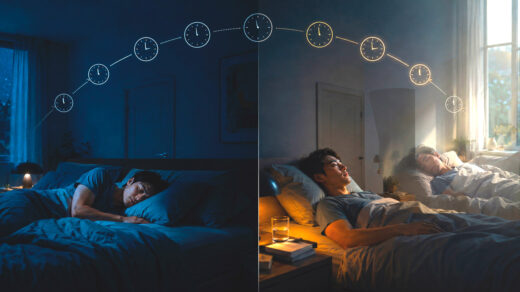
Fly from New York to Tokyo and the mismatch becomes impossible to ignore.
Local time says it is daytime. Your circadian system may still be operating as though it is night.
Night-shift work creates another version of the problem: behavior is repeatedly scheduled at times when internal biology may be promoting something very different.
Researchers call this circadian misalignment.
In the short term, the consequences are familiar: difficulty sleeping when you want to sleep, sleepiness when you need to function, and impaired alertness or performance.
Controlled laboratory experiments show that substantial circadian misalignment can also alter physiology. In one randomized crossover study, reversing behavioral and environmental cycles by 12 hours impaired glucose tolerance, largely through reduced insulin sensitivity.
Long-term observational research has also associated night-shift work with higher rates of conditions including type 2 diabetes and cardiovascular disease.
But this evidence needs an important boundary.
Shift work is not simply “staying up late.”
People working nights may also experience shorter or disrupted sleep, different eating patterns, occupational stress, socioeconomic differences, and changes in physical activity. Observational studies cannot neatly assign all long-term health differences to circadian misalignment itself.
And laboratory studies that invert day and night create far more severe disruption than an occasional late Saturday.
The mechanisms may overlap.
The exposures are not equivalent.
A Late Night Changes More Than Your Bedtime
This is one reason circadian advice gets confusing so quickly.
Suppose you stay up several hours later than usual.
You have not changed just one variable.
You stayed awake longer. You probably received light later. You may have eaten later. You shortened or shifted your sleep. And the next morning, you may encounter light at a different point in your biological cycle.
So when you feel terrible, what caused it?
Often, there is no single answer.
A 2026 experiment in adolescents illustrates how these factors can interact. Researchers progressively delayed bedtime, creating sleep opportunities ranging from 10 hours to 5.5 hours while simultaneously extending evening room-light exposure. Participants then received bright morning light intended to shift circadian timing earlier.
Those with the longest sleep opportunities shifted earlier. As bedtime became later, evening light exposure increased, and sleep opportunity shortened, the response to morning light became progressively weaker; the shortest-sleep group shifted later.
The study does not show that one short night damages the circadian system or that morning light becomes useless when you are tired. Because evening light and sleep opportunity changed together, their individual effects cannot be cleanly separated. The participants were also adolescents, whose circadian timing differs in important ways from that of many adults.
What the experiment demonstrates is more useful than a simplistic rule:
Your circadian system responds to context.
Morning light is not acting in isolation from everything that happened the night before.
Can Food or Exercise Reset Your Clock?
Light gets most of the attention, but what about meals and exercise?
Both can influence rhythmic physiology. The complication is that the body contains multiple clocks and rhythms, and they do not all respond equally to the same signals.
Light remains the dominant environmental timing cue for the central circadian pacemaker.
Food can strongly affect other rhythms.
In one controlled laboratory experiment, delaying meals by five hours did not significantly shift melatonin or cortisol rhythms, but it delayed the daily rhythm in blood glucose and shifted a molecular clock marker measured in fat tissue.
That distinction is exactly why saying a meal “resets your body clock” is not very informative.
Which clock?
Which biological marker?
And does changing that marker improve anything that matters to health?
Exercise can also influence circadian timing under some conditions, and researchers continue to study how exercise timing might be used strategically. But the evidence does not justify one universal “best” workout time for optimizing everyone’s circadian health.
A shifted rhythm is an interesting biological finding.
It is not automatically a health benefit.
Can You Measure Your Internal Time?
The clock on your phone can say 10 p.m. to everyone in the room.
Their bodies may disagree.
One person may already be well into their biological evening. Another may still be several hours away from it.
Scientists therefore use markers of circadian phase—essentially, where the internal timing system currently sits.
One of the most established is dim-light melatonin onset, or DLMO.
Under controlled dim-light conditions, researchers collect repeated saliva or blood samples and determine when melatonin begins its evening rise. DLMO is widely used as a marker of central circadian phase.
Notice what that requires: controlled lighting, repeated samples, laboratory analysis, and careful interpretation.
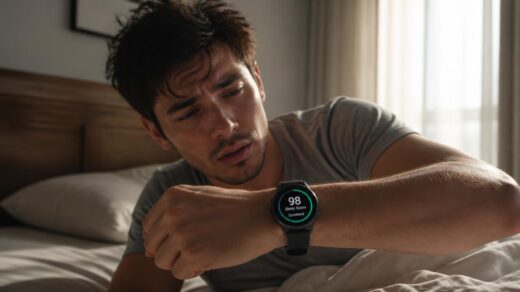
A smartwatch does something different.
Wearables can estimate sleep and wake patterns, movement, and—in some devices—light exposure. Researchers can combine such information with models that attempt to predict circadian phase.
But an estimated sleep schedule is not the same thing as directly measuring circadian phase.
Most people do not need laboratory circadian testing. The distinction matters mainly because consumer technology can make biological timing look easier to measure than it really is.
Do You Actually Need to Optimize Your Body Clock?
This is where useful science can become an exhausting wellness project.
Get exactly this amount of morning light.
Never vary bedtime.
Eat within the perfect window.
Exercise at the ideal circadian hour.
Measure everything.
The evidence does not require most people to live that way.
A more defensible approach is simpler.
Protect enough sleep. Circadian alignment cannot compensate for repeatedly sleeping too little.
Pay attention to your light-dark pattern. Light is the strongest environmental timing signal for the central clock. Daytime light and avoiding unnecessarily bright light at biologically inappropriate times can help support appropriate timing, although sensitivity varies substantially between people.
Keep your schedule reasonably stable when you can. Regular sleep and wake timing can make it easier for biological and social schedules to remain aligned. Perfect consistency is neither realistic nor necessary.
Respect individual timing. Genetics, age, light exposure, and social demands all contribute to chronotype. Not everyone will function best on exactly the same schedule.
And perhaps most importantly, do not turn optimization into the goal.
For most people, the useful question is whether sleep timing, sleep duration, light exposure, and daily obligations fit together well enough to support good sleep and daytime functioning.
Your Body Clock Is Really a Coordination System
The phrase “body clock” makes it sound as though there is one timer telling the body when to sleep.
The reality is more interesting.
Your circadian system helps establish biological timing.
Sleep pressure keeps track of prior wakefulness.
Light tells the central clock about the outside world’s day and night.
Meals, activity, and other behaviors can influence when different rhythms are expressed.
And your social schedule determines whether any of this fits the hours when you are actually expected to sleep, work, learn, care for someone, or be alert.
That is why the same symptom can have different explanations.
You may be sleepy because you have been awake too long.
Because your circadian system is entering biological night.
Because you are trying to function at a time your internal clock does not favor.
Or because several of those things are happening at once.
Understanding the distinction matters more than memorizing an ideal bedtime.
The body clock is not trying to force everyone onto the same schedule. It is helping the body anticipate a world that changes predictably between day and night.
The practical goal is not perfect circadian optimization.
It is giving your biology reasonably consistent information about when day is, when night is, and when you actually expect it to sleep and function.
That is what your body clock is really doing: not simply telling you when to feel tired, but helping your biology prepare for what comes next.